

1 Bottle 1 Story: Rhum Maniba

Today we are talking to you about a very - very - rare bottle of Maniba rum, whose size (98cl) and strength (60%) are enough to make the average person wonder. A bottle of Martinique rum that came out of the traditional radars and which is now just waiting to tell its story...
Maniba, the origin
A peaceful fishing village located about ten kilometers north of Fort-de-France, Case-Pilote was not only one of the first small towns in Martinique, it was also the birthplace of Maniba rum, well known to enlightened connoisseurs.
This rum is owed to a man, Raoul de Jaham, already manager of a distillery built in 1824 (an engraved stone attests to this) in Fond Boucher (a place located a few kilometers from Case-Pilote). Located on a former Sugar Plantation founded in 1670, its history is somewhat atypical: while it officially ceased to operate at the end of the 19th century, the governor of the island graciously gave it in 1903 to a certain Mr. Cambeille, as compensation for minor works carried out in Fond Lahaye (another neighboring fishing village). But - because there is always a "but" with gifts - with the obligation to restart the distillery for at least ten years... It is at this precise moment that Raoul intervenes, who takes over the management of the said distillery.
All the rum that will be produced from then on is unfortunately not traceable (if you have any leads, do not hesitate to contact us) but we can imagine that it will be sold in bulk and that without a doubt it will travel to many ports to end up under different brands, or that it will participate in blends as there were many at the time.
And the Maniba rum flowed
The continuation of our adventure takes us to 1918, on July 29 to be precise, when a decree published in the Official Bulletin of Martinique informs us that Raoul de Jaham is authorized to transfer the Fond Boucher distillery to his property of Moulin à Eau, already the scene of a past sugar activity: Moulin à Eau is in fact an old sugar plantation that initially belonged to the Le Pelletier Saint-Rémy family (in 1820), and which will take its (final) name of Habitation Moulin à Eau in 1882. The plantation will subsequently become the priority of the Jahamn family, who will therefore build our famous distillery in 1918 on the remains of Fond Boucher.
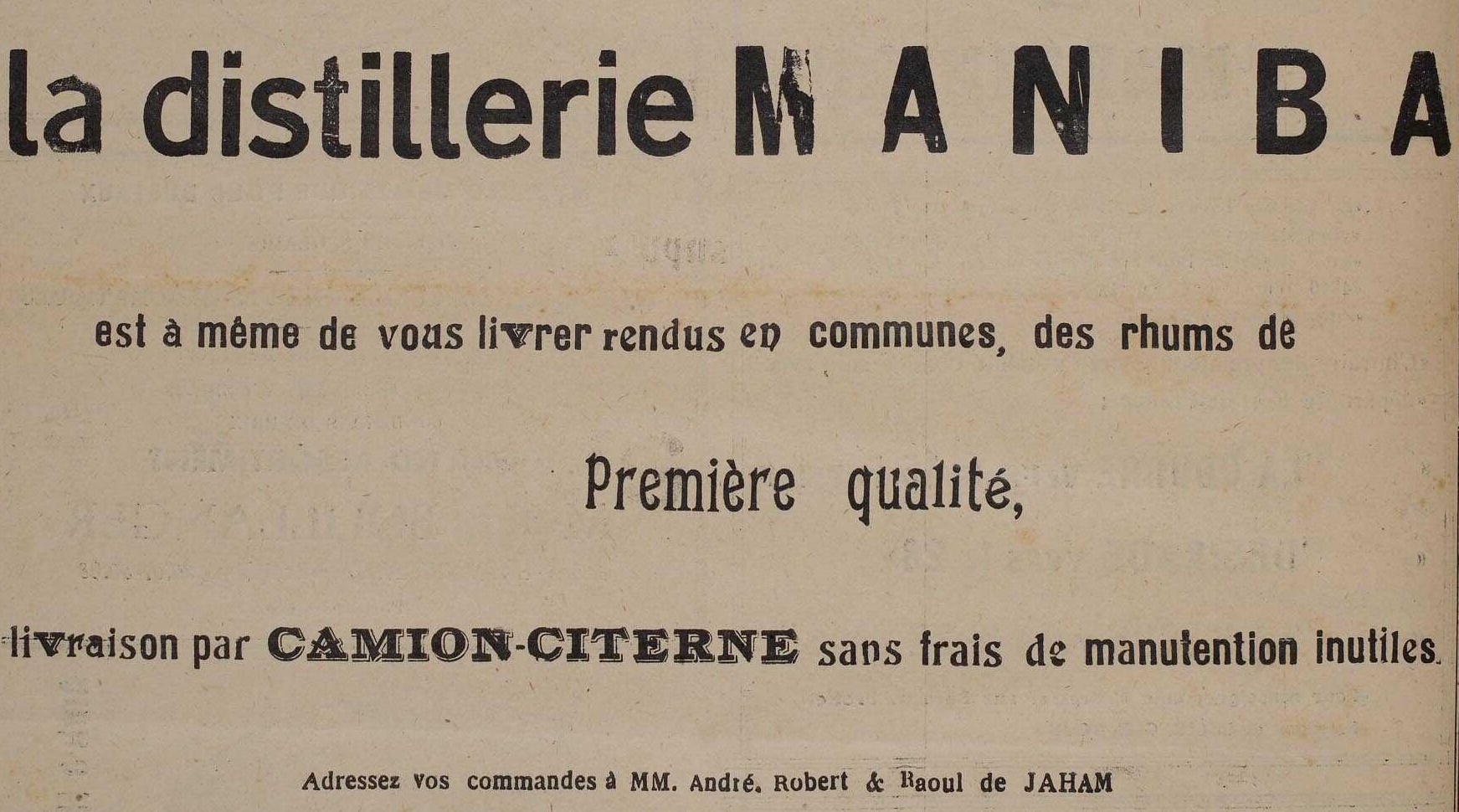
It is at this time that the Maniba rum brand was created, of which we can still find here and there old bottles of rum, more or less well (but often less well) preserved. A few years after the start of rum production, in 1922, the Moulin à Eau distillery was transformed into a sugar refinery to cope with the contingent law which then limited the quantity of rum produced (and which limited the number of litres of rum which had to be exported). Unfortunately, we do not know the quantity of rum produced at this time, but we do know that the distillery offered rum in bulk, as evidenced by this advertisement – full page – published in the newspaper "La Petite Patrie" (N°622) from March 5, 1955 :
A break, and it starts again
In 1956, the distillery stopped and not a drop of rum flowed. It was then sold, with its estate which included a hundred hectares of sugar cane, to several families who were shareholders of S.A. Maniba (the Asselin, Maille, Aubery and Dorne families). The cane was sent to the Lareinty factory, located in Lamantin. Founded in 1862 by Émile Bougenot, this factory was at the time the flagship of the sugar economy of Martinique. At the end of the 19th century, its agricultural estate extended over more than 1900 hectares and the factory could cook up to 25 barrels of sugar per day.
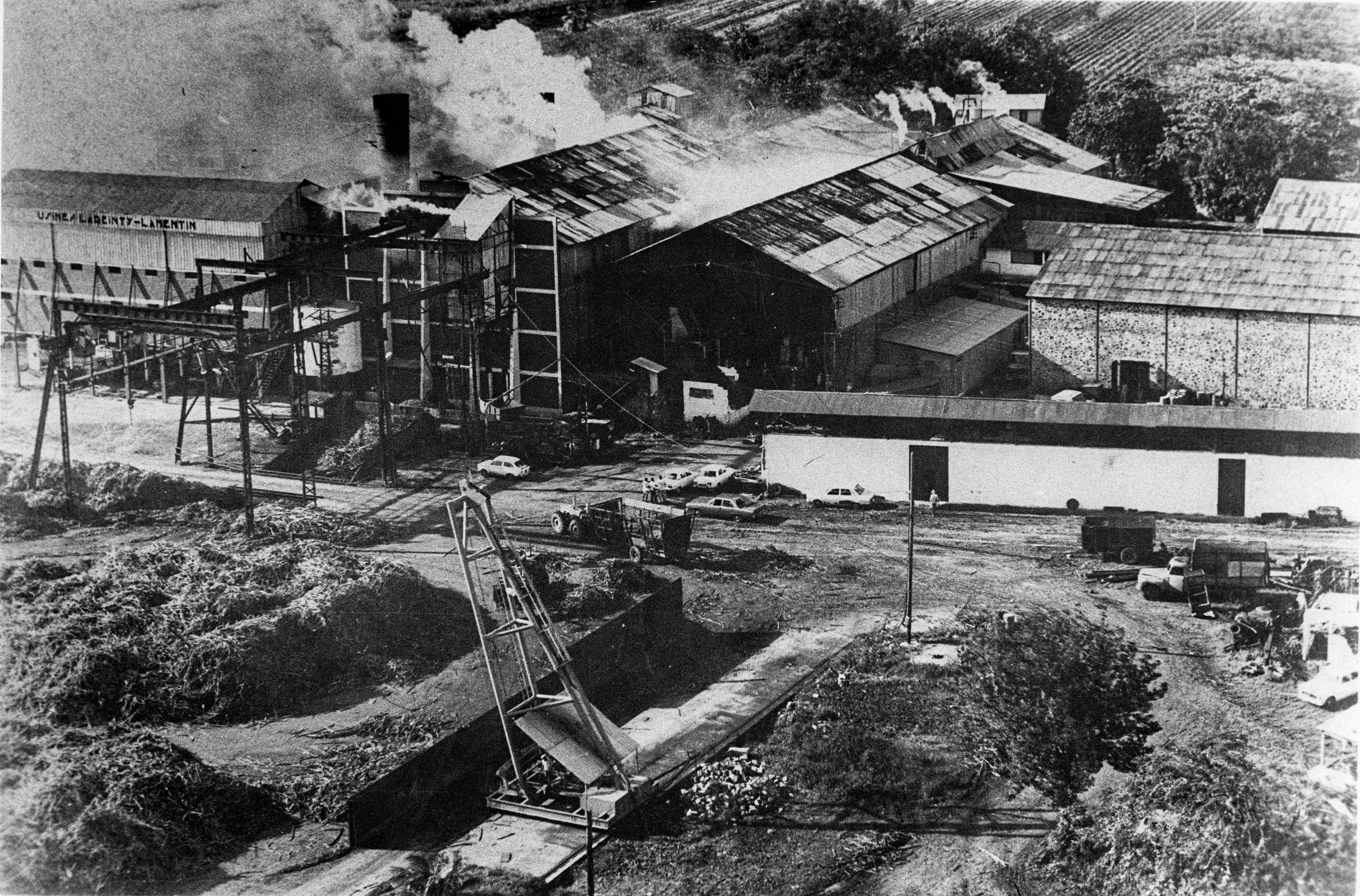
Archive photo of the Lareinty factory in 1960 (source : Patrimoines Martinique)
But three years later, in 1959, the Moulin à Eau distillery was restarted: it was equipped with a Creole column and then, in 1962, a Savalle column to produce grand aroma (high ester rum) intended for export. The distillery would sail its boat for a while, but would stop again, this time definitively, in 1974... The Maniba sugar factory would follow and suffer the same, and sad, fate (in 1980).
The column was sold to Trois-Rivières and the contingent to the Saint-James distillery which would perpetuate the brand. Like Bally and many other great rum producers, Maniba is today just one name among many others, but has the merit of remaining present on the market, and in people's memories. Only one white rum is marketed today by Saint-James: a non-AOC rum (understand a blend of agricultural rum and molasses rum from the French Antilles).
A unique Cuvée Maniba, a vestige of the past

Let's go back to 1974, the year when the Moulin à Eau distillery, the stronghold of Maniba rum, officially closed its doors. The story goes that a special vintage was bottled to mark the occasion, or perhaps more to soften the farewell as much as possible.
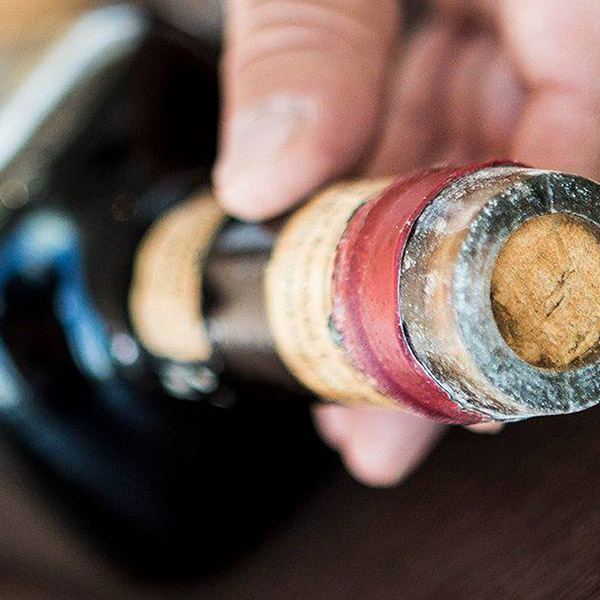
In order to make a final gift to the shareholder families of S.A. Maniba (the Asselin, Maille, Aubery and Dorne families), an old rum was specially bottled with the means at hand: old bottles from the distillery, those previously used for the white agricultural crystal rum (which had an alcohol content of 50%), were used to hold this final gift. And since there was no question of creating labels for the occasion, it was decided to change the alcohol content by hand and with a pen, transforming the 50 into 60, the alcohol content of the freshly bottled old rum.
The thick, wide-shouldered glass that holds this treasure dates from the mid-20th century, and the aluminum capsule only confirms the date of the package. But what exactly is the rum itself? And how old is it?
....
Another story says that the rum was bottled in the 1950s/1960s and offered to the shareholders of the distillery when it closed (which, let's remember, happened in 1974). In anticipation then? Admit that there is little chance... Or, this kind of bottles would have been previously offered, like a family vintage was made for Bally? This is a hypothesis that could be plausible, if we take into account this bottle, found in an old eBay ad:

In any case, this photo proves that an old rum, with a 60% alcohol content, once existed. From there to knowing if it was a bottling that was marketed, or offered... the mystery remains :) But let's count on the passage of time, which, failing to erase the buildings, often brings out new echoes of the agitations of the past...
PS: Concerning the distillery, it will be bought by the Monplaisir family, who will resell it much later.