
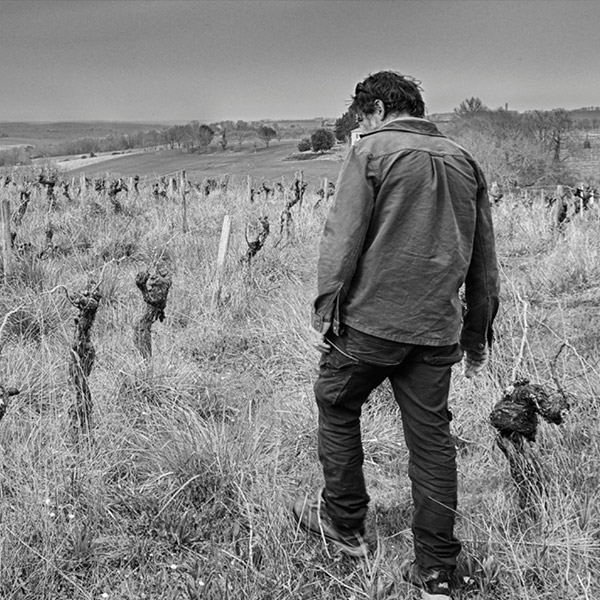


Patrick Michalouski

Once the campaign was over, at the age of 24, he decided to leave his economics studies for good to officially become a nomad distiller in October of the same year, espousing the ambitions that his father carried within him. Fearing a workload and responsibilities then too great for his young age, he decided that he would only distill at the property, that is to say directly at the winegrowers wishing to transform their wines into Armagnac.
Since October 1981, Patrick has been distilling uninterruptedly
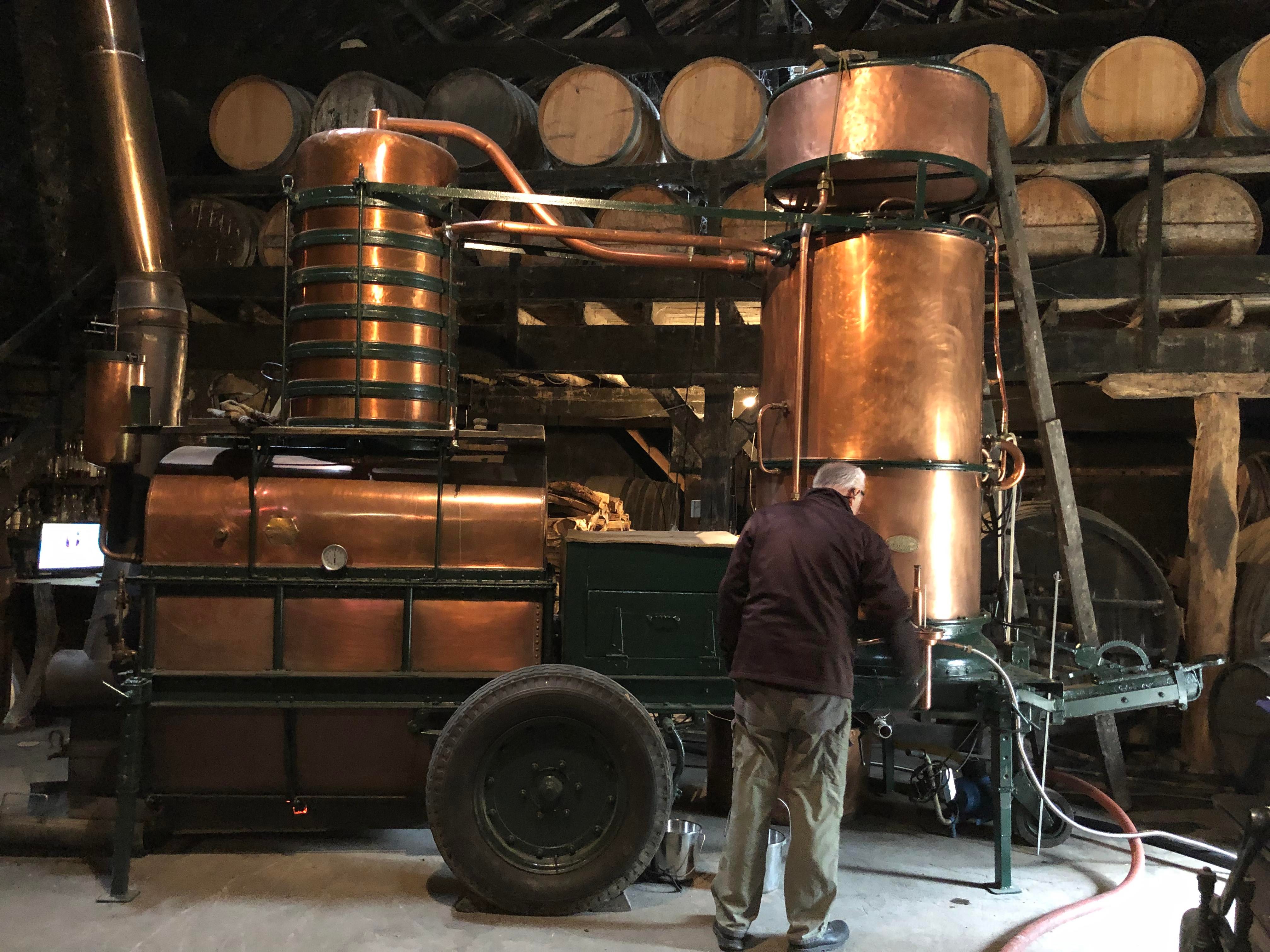
Despite increasingly unpredictable climatic hazards, he steers his boat paying particular attention to his still, which he pampers in every way: an Armagnac still inherited from his father and in perfect working order that he knew evolve over time without ever changing his habits. All his customers will tell you that Patrick Michalouski is a maniac of the still and his reputation is second to none. The state of operation but also the hygiene which surrounds the distillation are irreproachable here. He thus makes a point of scrupulously respecting both the inside and the outside of his machine, carrying out cleanings as thorough as they are essential, before, during and after each intervention. It is no coincidence that he has found a passion for old machines among which we can find a still dating from 1936.
When the distillation season approaches in October, it is therefore a brand new looking still that arrives at its customers. The ceremonial is always the same: set up the still, level it, then make sure it's full of water. Bring the first wood and keep it warm as long as necessary. The Armagnac Blanche will thus flow from one domain to another, from a castle to a farm and everything will follow. The distillation is carried out continuously, the human presence is constant, 24 hours a day: Patrick intervenes from 2 a.m. to 2 p.m., leaving the rest to an employee before returning to take his turn if the volume distilled requires it. The correct years, he works for 3 and a half months, the bad (like last year) 1 month and the very good, much rarer, 4 months (the AOC allows distillation from October to March but the volume of armagnac is usually not large enough for the distillation to continue until March). Intense work at all times where you have to be available and alert seven days a week and 24 hours a day.
On the distillation side, with a few rare exceptions, his customers let him find the perfect degree to distill their wines according to the purpose of the Armagnac: the distillation will thus be different if it is intended for aging (according to the barrels), to be tasted as such (to make a Blanche for example) or to make Floc de Gascogne. But the distiller must also deal with the quality of the wine offered by his customers, a wine which according to Patrick has undergone many changes over time.
The distillation is done almost systematically by grape variety to keep their typical characteristics and in all cases, the relationship of trust is total and the work of a year is put in the hands of the distiller. As Patrick likes to humbly remind his customers, he cannot improve their product, the better he will respect it. It is a matter of trust and dialogue, advice and experience. The transmission is constant and the advice always rich to distill. In terms of volume produced, Patrick will distill 2000 hectoliters of pure alcohol over an average season, the equivalent of 1000 barrels, knowing that 90% of this volume is actually aged. He can count on four stills which all belong to him and which help him absorb larger volumes, not hesitating to heat two at a time when necessary. As with his most important client, the Domaine de Pellehaut, where he stays almost three weeks non-stop with two of his stills.
When we ask him about the changes that have occurred during his 41 years of distillation, Patrick tells us about the size of the farms which have gradually shaped his activity and even drastically reduced the number of his customers: the small farms of yesterday which made 10 hectares now make up 30 or 40 and the largest can reach 400 hectares, increasing its address book from around fifty customers to around ten today.
Even the production of Armagnac is no longer as important as it used to be, causing very strong fluctuations over the years in terms of distillation: Patrick remembers having chained his most important campaign during the year 1984 before seeing his volume distilled divided by six the following year because of the frost. Hard knocks from which it generally takes several years to recover. The last three years have not been outdone with a Covid which has seen wine consumption soaring, encouraging winegrowers to abandon Armagnac more for the production of wine. As a sign of fate, the spring frost of 2021 caused volumes to drop again, joined the following year by hail and drought for what will remain - we hope - the smallest campaign of its career.
In love with his profession but conscious of his -increasingly- unpredictable character, Patrick knows that he will continue to distill for as long as possible, even if to hear him he would not start this adventure again for anything in the world if nature agreed to give him back his twenty years. A computer scientist on his own, he has never been able to make a living from an activity as seasonal as it is unstable and is now struggling to find a younger than him to whom to pass on his know-how. Knowing that it takes an average of ten years to properly train someone according to him, we advise you to send him your CV as soon as possible if you feel like it :)