


Thematic Lemon Hart

A merchant from Cornwall, shipments of rum destined for the Royal Navy, thirty-year-old Jamaican rums and, a few decades later, Hollywood's first tiki cocktails... At first glance, these worlds seem far removed from one another. Yet they are all connected by a single name: Lemon Hart.
Today, rum enthusiasts are most familiar with its famous Demerara 151 proof, which has become an essential reference in the world of tiki. But behind this bottle lies a much older story: that of a family of merchants, a London-based firm and rums of sometimes very different origins, whose history spans centuries and continents.
From the earliest Jamaican rums to contemporary blends, we have set out to trace the fascinating history of Lemon Hart. And as you will discover, there are still plenty of surprises hidden behind the legend...
The Harts of Penzance, long before the first Lemon Hart
In the 18th century, Penzance, a small port at the far end of Cornwall in southwestern England, lived to the rhythm of ships and maritime trade across the Atlantic. Among the merchants involved in this activity was a family whose name, still unknown to rum enthusiasts, was destined to endure for centuries: the Harts. It is here, far removed from tiki cocktails and the famous bottles of 151 proof, that the story of Lemon Hart begins.
The story begins around 1720, with the arrival of Abraham Hart, from a Jewish family originally from Weinheim, in the Rhineland. Also known as Solomon Lazarus, he settled in Penzance and developed his trading activities. According to the research of historian Keith Pearce, he may have begun importing Jamaican rum, having reportedly visited the island himself in the 1750s. The surviving archives do not allow us to reconstruct his earliest business dealings in detail, but one thing is certain: the commercial history of the Harts began long before 1804, the date that the brand still highlights today.
His son, Lazarus Hart, also known as Eleazer, continued and expanded the family business. The family was involved in maritime trade and invested in ships, including the Nancy and Betsy, of which Lazarus was a co-owner as early as 1787. Jamaican rum was an important commodity in trade between the British West Indies and the ports of the United Kingdom, within a colonial economy whose production relied heavily on the labour of enslaved people.
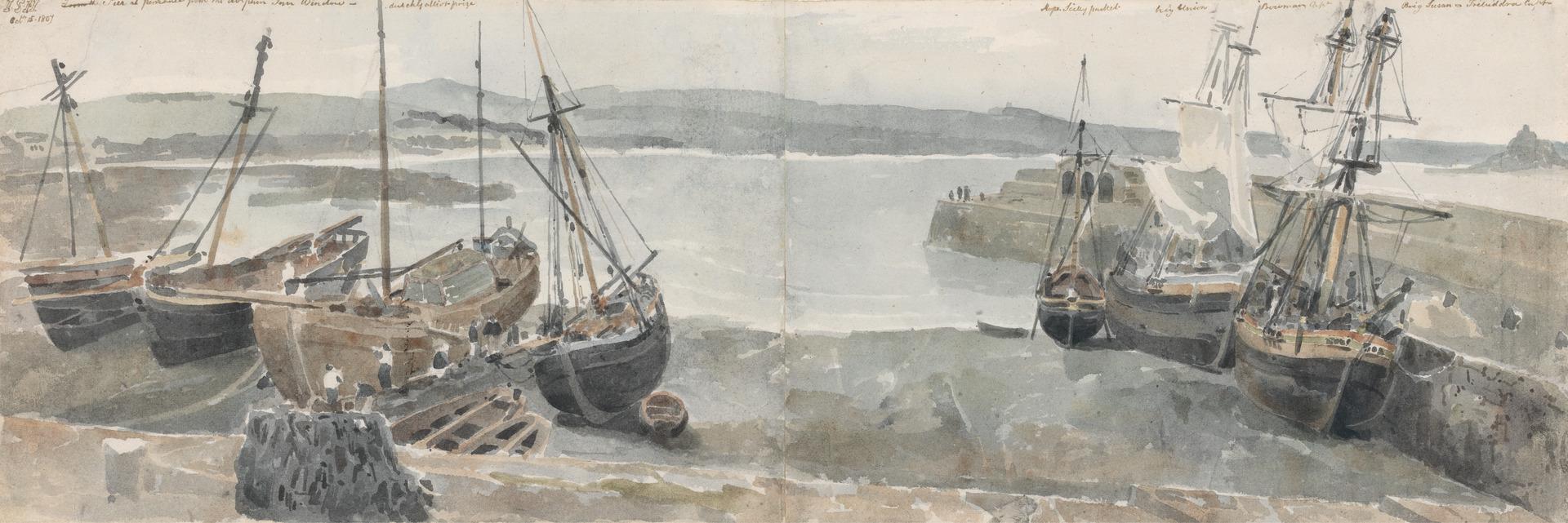
Penzance harbour on 15 October 1807, seen from a window of the Dolphin Inn. Original watercolour by John Samuel Hayward. Yale Center for British Art, collection B1986.29.536.
It was in this environment that Lemon Hart was born on 31 October 1768, the grandson of Abraham. Contrary to what the traditional story of the brand might suggest, he was not an entrepreneur who appeared out of nowhere at the beginning of the 19th century. He already represented the third generation of a merchant family. From an early age, he was involved in his father's business, gradually taking on a central role in the enterprise.
By the turn of the century, his business interests were already well established. In 1802, Lemon Hart was listed among the six co-owners of the Amelia, a vessel registered in Penzance. Three years later, he also acquired a share in the Speculation, a newly built ship in the port. These investments reveal a merchant directly involved in maritime trade, although the precise cargoes carried by each of these vessels remain unknown.
But the year 1803 was also marked by two personal tragedies... Lemon Hart lost his father, Lazarus, and then his first wife, Letitia, who died following a tragic domestic accident in October. He thus inherited responsibility for the family business during a particularly difficult period. The following year, he married Mary Solomon and continued developing his commercial activities.
Lemon Hart was also an important figure within the small Jewish community of Penzance. In 1807, his name appeared among the signatories of the deed concerning the rebuilding of the synagogue in New Street, behind the Star Inn. He subsequently became the first president of the congregation in its new building in 1808. Behind the rum merchant, then, emerges a real historical figure, deeply involved in both the economic life of the town and the affairs of his community.
And what about that famous year 1804, which still appears on Lemon Hart bottles today? It corresponds to the period when the merchant's own business activities began to flourish, but it does not mark the true beginnings of the family trade. The Harts' commercial tradition stretched back several decades earlier. The date has become a symbol of the brand, without telling the whole story of its origins.
The business then entered a new phase: in 1806, Lemon Hart entered into a partnership agreement with his nephew, Jacob James Hart, then in his twenties. One of the main objectives was to expand the firm's activities in London, where Jacob was to oversee the business. And this time, we are not relying solely on accounts published many years later: The London Archives holds a collection of business documents dating from 1806 to 1848, including a copy of this partnership agreement. A valuable historical record that could still reveal much more about the early days of the London firm.
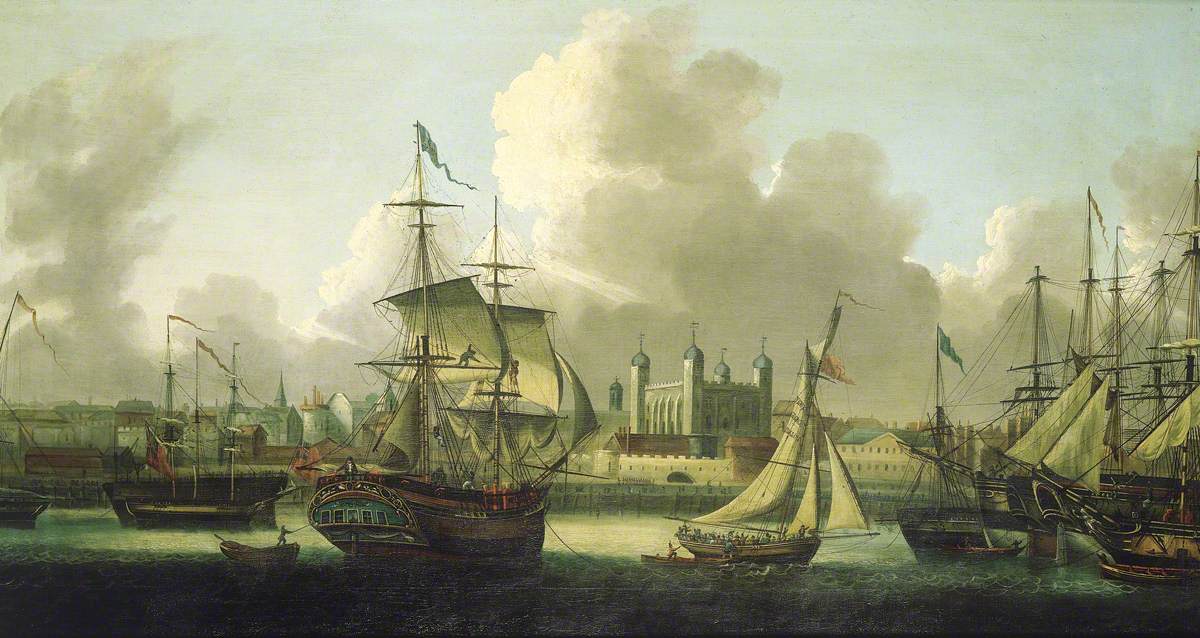
The Pool of London, at the heart of British maritime trade in the late 18th century. Painting by Robert Dodd, Shipping in the Pool of London. Royal Museums Greenwich, BHC1879.
And the choice of London was no coincidence... The British capital was then one of Europe's great centres of colonial trade. Ships unloaded goods arriving from every corner of the Empire, while merchants, brokers and warehouse operators organised their distribution. For a firm specialising in wines and spirits, establishing a presence there offered opportunities far greater than those available in the Cornish market alone.
The London business appears to have prospered rapidly. Around 1811, Lemon Hart decided to move to the capital himself, leaving the supervision of his interests in Penzance to his nephew Lemon Woolf, who was also a wine and spirits merchant. Commercial records mention several successive London addresses for the firm, including 59 Fenchurch Street, Lower Thames Street and Water Lane, in the Tower Street district. A new chapter was beginning for the family enterprise.
When Lemon Hart died in Brighton in 1845, the firm already bore a name destined to outlive him. His son David took over the business, while its London operations continued to develop. But in the meantime, the Harts had begun supplying a customer of an entirely different stature: the Royal Navy. And it is precisely this relationship that would give rise to one of the greatest legends surrounding the brand...
Lemon Hart and the Royal Navy, the story behind the legend
For more than two centuries, the name Lemon Hart has been closely associated with the Royal Navy. Some vintage bottles even bear the words "Suppliers to the Admiralty", while the brand's official history proudly presents its founder as the first supplier of rum to the British Navy... A wonderful story, certainly, but what do the historical records actually tell us?
To understand this relationship, we need to return to the 19th century, when rum was part of everyday life for British sailors. Since the 18th century, the Royal Navy had distributed a daily spirit ration to its crews, a tradition that became increasingly regulated and would survive until 1970. The famous rum tot had become a true institution aboard British warships. For the Admiralty, securing its supply represented a considerable undertaking, requiring enormous quantities of rum and involving the major London trading houses.
It was in this context that Lemon Hart & Son developed its relationship with the Navy. Following Lemon Hart's death in 1845, his son David Hart continued the family business...
On 9 March 1849, the Irish newspaper Waterford News reported that Lemon Hart & Son, based at 59 Fenchurch Street in London, had secured a government contract for 50,000 gallons of rum destined for the Navy. A year later, in its 16 March 1850 edition, The Economist announced another contract awarded to the same firm, this time for 100,000 gallons! These few lines, buried among commodity prices and commercial reports, are valuable historical evidence. They confirm that Lemon Hart was indeed a supplier to the Royal Navy in the mid-19th century.
However, another supplier's name also appears in the Admiralty records: ED&F Man. Founded in 1783 by James Man, this London trading house traces its first naval contract back to 1784, twenty years before the date of 1804 generally associated with Lemon Hart. It would retain a central role in the Royal Navy's rum purchases until 1970. Depending on the period, merchants could offer their own stocks, while brokers were responsible for organising purchases on behalf of the Admiralty.
An official testimony helps shed light on this arrangement. In 1908, appearing before the British Royal Commission on Whisky and Other Potable Spirits, Frederic Henry Dumas Man, representing ED&F Man, stated that his firm purchased all the rum intended for the Navy. This does not call into question the Lemon Hart contracts documented fifty years earlier, but it reminds us of the importance of distinguishing between the different participants in naval procurement. The Hart firm sold rum to the Navy; it did not necessarily control the entire purchasing and preparation process.
And what exactly happened to those thousands of gallons once they had been purchased? Contrary to what one might imagine, the rum served to sailors did not come directly from the casks of a single merchant. Instead, it was sent to the Royal Navy's major victualling establishments, particularly Deptford, on the River Thames, where rums from different sources were combined in enormous vats to produce a blend meeting the Admiralty's requirements.
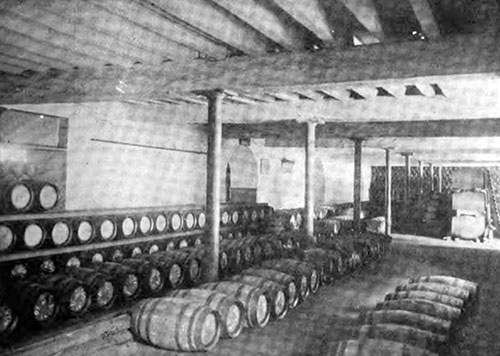
The rum stores at the Royal Victualling Yard in Deptford, around 1900. Photograph published in "How the Navy is Fed", by Frederick Dolman, The English Illustrated Magazine, October 1900.
A report published in October 1900 in The English Illustrated Magazine even offers us a glimpse behind the scenes of these facilities. Journalist Frederick Dolman described 32 enormous vats, with a combined capacity of approximately 230,000 gallons. The largest alone could hold more than 32,000 gallons, or over 120,000 litres! The rum was blended and brought down to the regulation strength before being transferred into casks for distribution to the various ships.
The report explains that the rum was then purchased at a strength of up to 40 degrees British overproof, equivalent to approximately 80% alcohol by volume, before being diluted to 4.5 degrees underproof, or around 54.5% ABV. This helps clear up a common misconception among rum enthusiasts: the famous Lemon Hart 151 proof, bottled at 75.5% ABV, was not simply the equivalent of the sailors' daily ration. Different strengths existed for different purposes, and the words "Royal Navy" on a commercial bottle did not necessarily mean that it contained exactly the same blend as the rum served aboard British warships.
But another question remains: which rums actually went into these naval blends? Over the decades, the Royal Navy sourced rum from various producing regions, particularly British Guiana, Trinidad and Barbados. Jamaica also contributed at certain times, although its role varied considerably. By the early 20th century, the most characterful Jamaican rums were generally considered too distinctive and too expensive to make up a significant proportion of the standard naval blend.
And this is where Lemon Hart has another surprise in store for us. During the Second World War, as shipping routes were disrupted and the Admiralty struggled to secure the quantities it required, the British Navy was forced to broaden its sources of supply. Among commercial records from 1944, rum historian Matt Pietrek uncovered a document showing ED&F Man purchasing, on behalf of the Admiralty, Jamaican rums supplied by Lemon Hart & Sons Ltd.
For anyone interested in vintage rums, this document is fascinating. It does not merely identify a geographical origin: it distinguishes several technical rum marks, including PGR/E and R.H., as well as a third whose identification remains uncertain. These codes were used to distinguish distillates with their own particular characteristics. The contract also specifies the 1944 crop, indicating that the rums purchased were recent productions rather than old stocks that had undergone lengthy cask ageing.
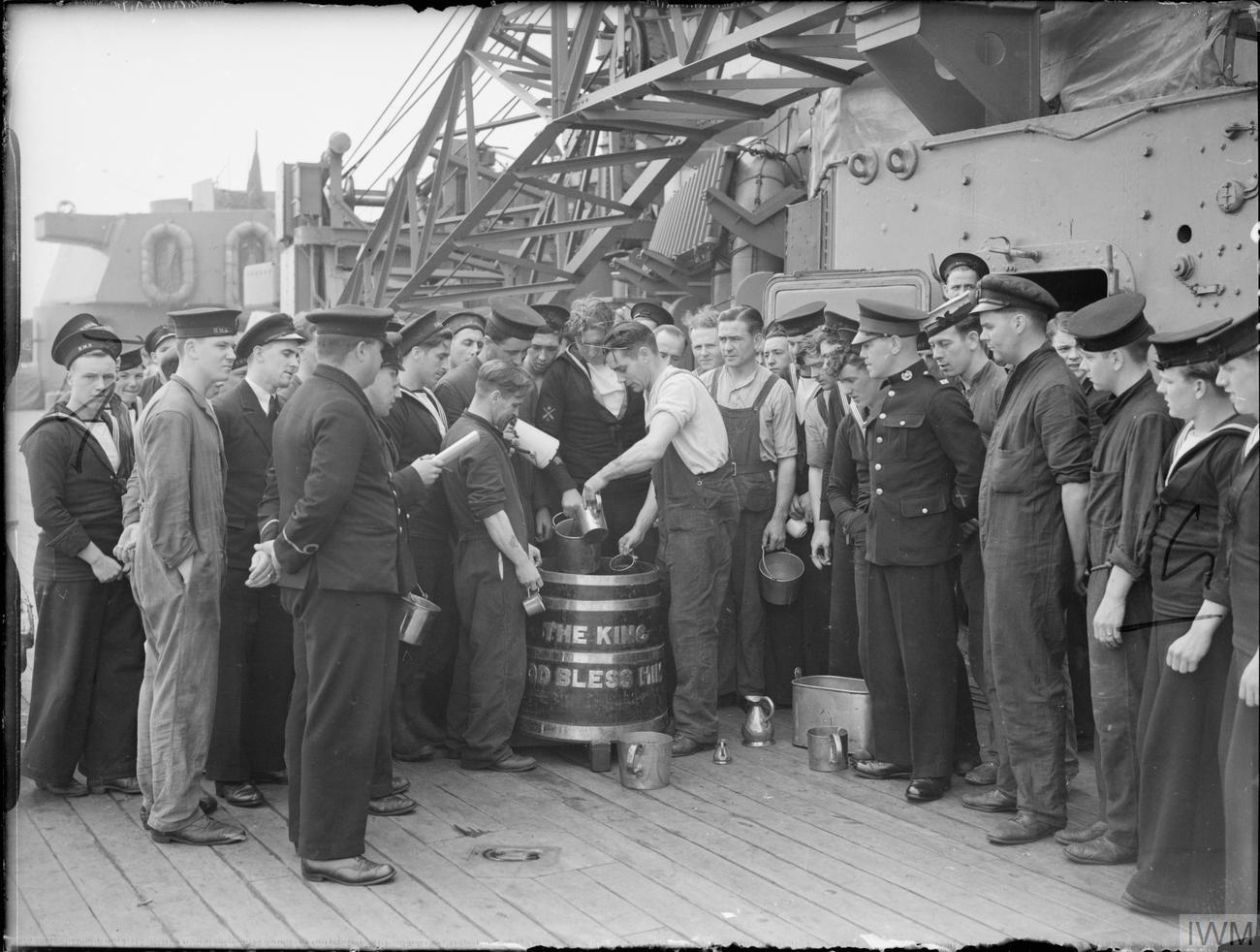
The daily rum ration being distributed aboard HMS Rodney during the Second World War. Official photograph by Reginald George Guy Coote, Imperial War Museums, reference A 103.
This 1944 archive is particularly revealing. Almost a century after the contracts secured by David Hart, the Lemon Hart firm was still involved in supplying the Royal Navy. But above all, it reveals a reality that is often overlooked: Royal Navy rum was never based on a completely fixed recipe. Its origins, producers and distillates evolved over time, depending on availability, changing circumstances and the needs of the Navy.
On 31 July 1970, this long tradition officially came to an end. It was the famous Black Tot Day, when the Royal Navy distributed the daily rum ration to its sailors for the last time. After centuries of tradition, a chapter in British maritime history had finally come to a close...
For Lemon Hart, however, the Royal Navy name would live on through its labels. And behind this prestigious association lies an essential distinction: the rum sold commercially under the Lemon Hart brand was not necessarily identical to the rum it supplied to the Admiralty. On one side were bulk contracts intended to meet the Navy's requirements; on the other, a merchant house offering its own selections and blends to consumers.
From Jamaica to Demerara, the many faces of Lemon Hart
Today, when Lemon Hart is mentioned, rum enthusiasts almost immediately think of Demerara 151 proof, that exceptionally powerful rum which has become inseparable from the great tiki cocktails. Yet a closer look at the firm's old labels reveals a very different story... For decades, Lemon Hart offered Jamaican rums, Demeraras, light and full-bodied blends, and even very old rums boasting several decades of ageing. A reminder that behind the Lemon Hart name was, above all, a firm of rum merchants and blenders.
And this diversity is nothing new. In the New Zealand Times of 27 September 1878, a commercial advertisement published in Wellington offered three Lemon Hart products: 30 cases of rum at 12 degrees overproof, 15 cases at 33 degrees overproof, and 150 cases of Jamaica Rum. For rum enthusiasts, these details are fascinating for several reasons: under the old British proof system, 12 degrees overproof corresponds to approximately 64% alcohol by volume, while 33 degrees overproof represents almost 76%, a strength comparable to that of the future Lemon Hart 151! This advertisement therefore demonstrates that, as early as the 19th century, Lemon Hart was marketing several types of rum at different strengths, and that particularly powerful expressions were already part of its range.
Among the firm's most remarkable products were its old Jamaican rums. On 4 November 1932, a brand named "Lemon Hart Rum – Very Old Jamaica" was the subject of an official registration, under number 536352. Its historic label, reproduced in a document devoted to Jamaican trademarks published by the World Intellectual Property Organization, illustrates the importance attached to the origin and age of these rums. But the bottles that have survived the passage of time tell us even more...
Here is a particularly interesting example: a 17-year-old Lemon Hart Liqueur Jamaica Rum, bottled at 86 US proof, or 43% ABV. This bottle, attributed to the 1930s, bears the words "Of Superb Quality" and indicates that it was bottled in London by Lemon Hart & Son. The label also mentions Julius Wile Sons & Co., New York, identified as the exclusive agent for the United States. What we have here is a genuine selection of aged Jamaican rum intended for the American market, a far cry from the familiar image of Demerara overproof alone:
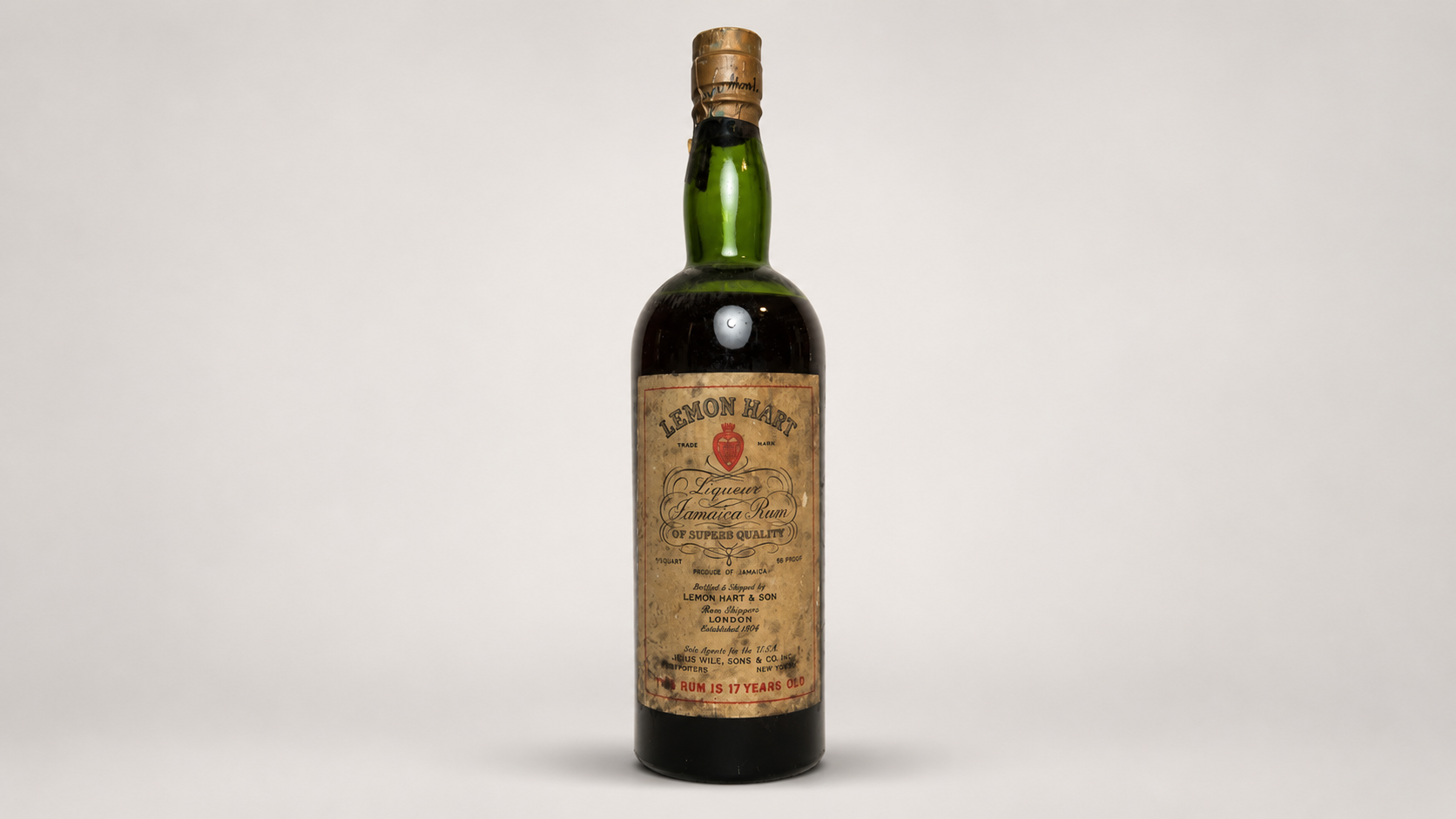
Lemon Hart Liqueur Jamaica Rum, 17 Years Old, 43%, attributed to the 1930s. Bottled in London for the American market, with Julius Wile Sons & Co. as exclusive agent. Photograph: Old Spirits Company.
But that is not all! Another bottle, sold by Spectrum Wine in July 2020, displays an astonishing 28 years of ageing, again at 86 US proof. Its state of preservation, with its original capsule and a Californian tax stamp dated 1938, suggests that it was bottled towards the end of the 1930s. And here too, the label carries a particularly interesting statement: the rum was reportedly matured in its original cask before being bottled by Lemon Hart & Son in London.
This statement raises a fascinating question: where did these old Jamaican rums actually mature? In Jamaica, before being shipped overseas? In the firm's London warehouses? Or did ageing practices vary from one expression to another? Whatever the answer, these old labels provide valuable evidence of the commercial practices of the period.
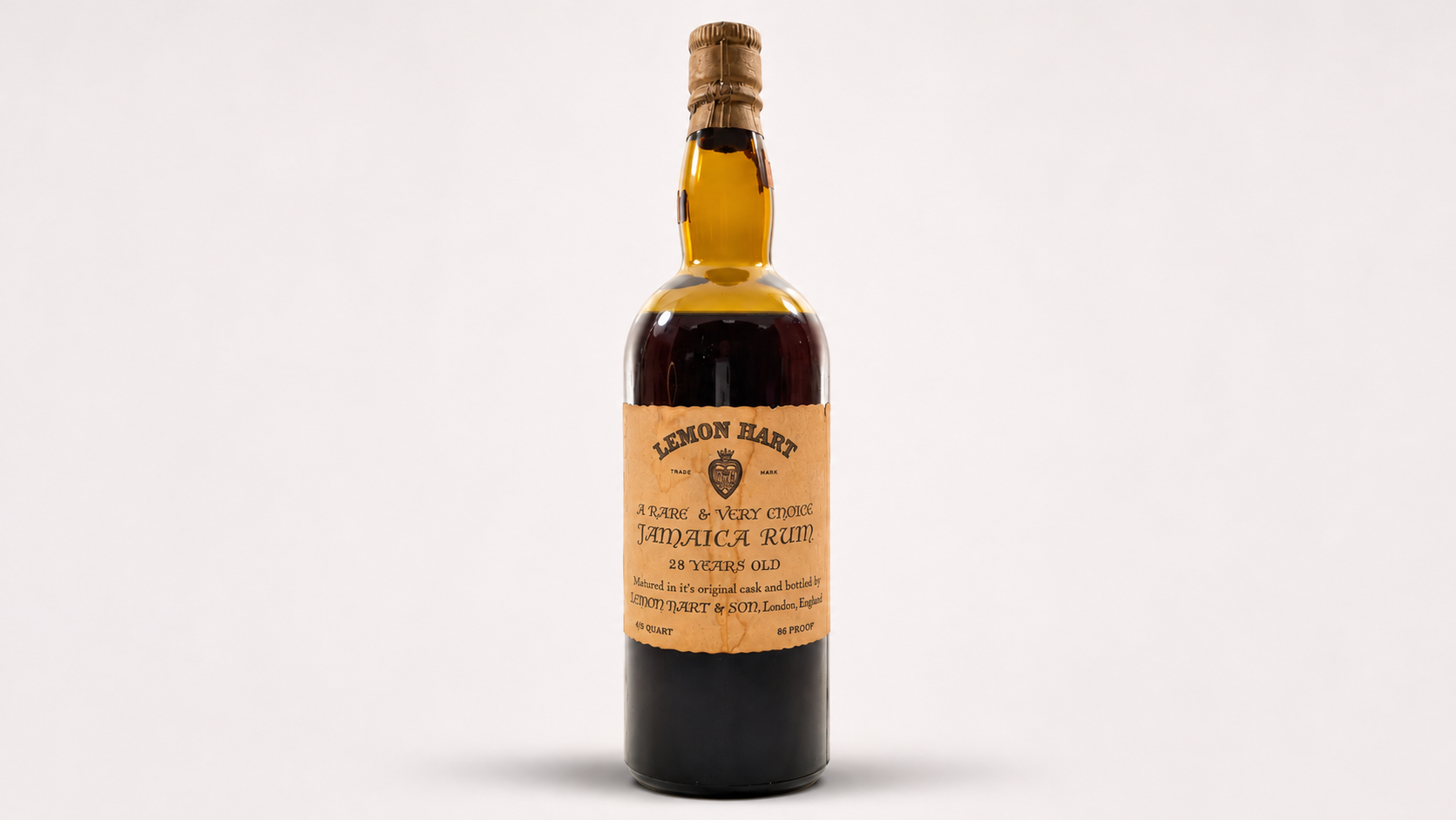 Lemon Hart Jamaica Rum, 28 Years Old, 43%. A bottle attributed to around 1938, bearing a statement that the rum was matured in its original cask before being bottled in London. Photograph: Spectrum Wine, auction of 2 July 2020, lot 1303.
And there is an even older expression (yes, really)! An auction held by Skinner in April 2018 documented a 30-year-old Lemon Hart Jamaica Rum, bottled at 43%, presented in an unusual pyramid-shaped bottle and attributed to around 1933. Even more surprisingly, an American trade price list published in the Arizona Beverage Journal (page 55) in August 1957 still listed a "Lemon Hart Jamaica – 30 Years Old", at 86 proof, with a suggested retail price of $8.73. We do not know whether the bottles from the 1930s and the expression still offered in 1957 came from the same stocks or from successive blends. But this confirms that a 30-year-old Jamaican rum remained part of Lemon Hart's commercial range for many years.
Behind these impressive age statements, however, one major mystery remains: which Jamaican distilleries actually produced these rums? The labels emphasise their origin, their age and the reputation of the London firm, but they do not allow us to identify the producers precisely. It would be tempting to attribute these bottles to some of the island's great historic distilleries, but for now, there is no evidence that would justify doing so.
And while Lemon Hart was developing its Jamaican rums, Demerara also occupied an important place in its business. This region of British Guiana, which became the independent nation of Guyana in 1966, has a long tradition of sugar production and rum distillation. Its distilleries used different types of stills, including pot stills and column stills, allowing them to produce a wide variety of distillates. We should therefore not imagine a single Demerara style, but rather an entire family of rums, sometimes with very different flavour profiles.
An official British Columbia price list dating from 1932 mentions two distinct expressions: Lemon Hart Demerara Proof and Lemon Hart Demerara Overproof. Once again, in the early 1930s, we find this coexistence of different strengths and origins that had already characterised the firm in the 19th century.
Fortunately, we have an exceptional document that helps us understand how these rums were selected and blended. In 1951, United Rum Merchants, the group to which Lemon Hart now belonged, published a booklet entitled Rum: From the Cane to the Consumer, written by Arthur Woolley. This professional account takes us behind the scenes of the firm's rum production and blending operations, at a time when the group was working primarily with rums from Jamaica and British Guiana.
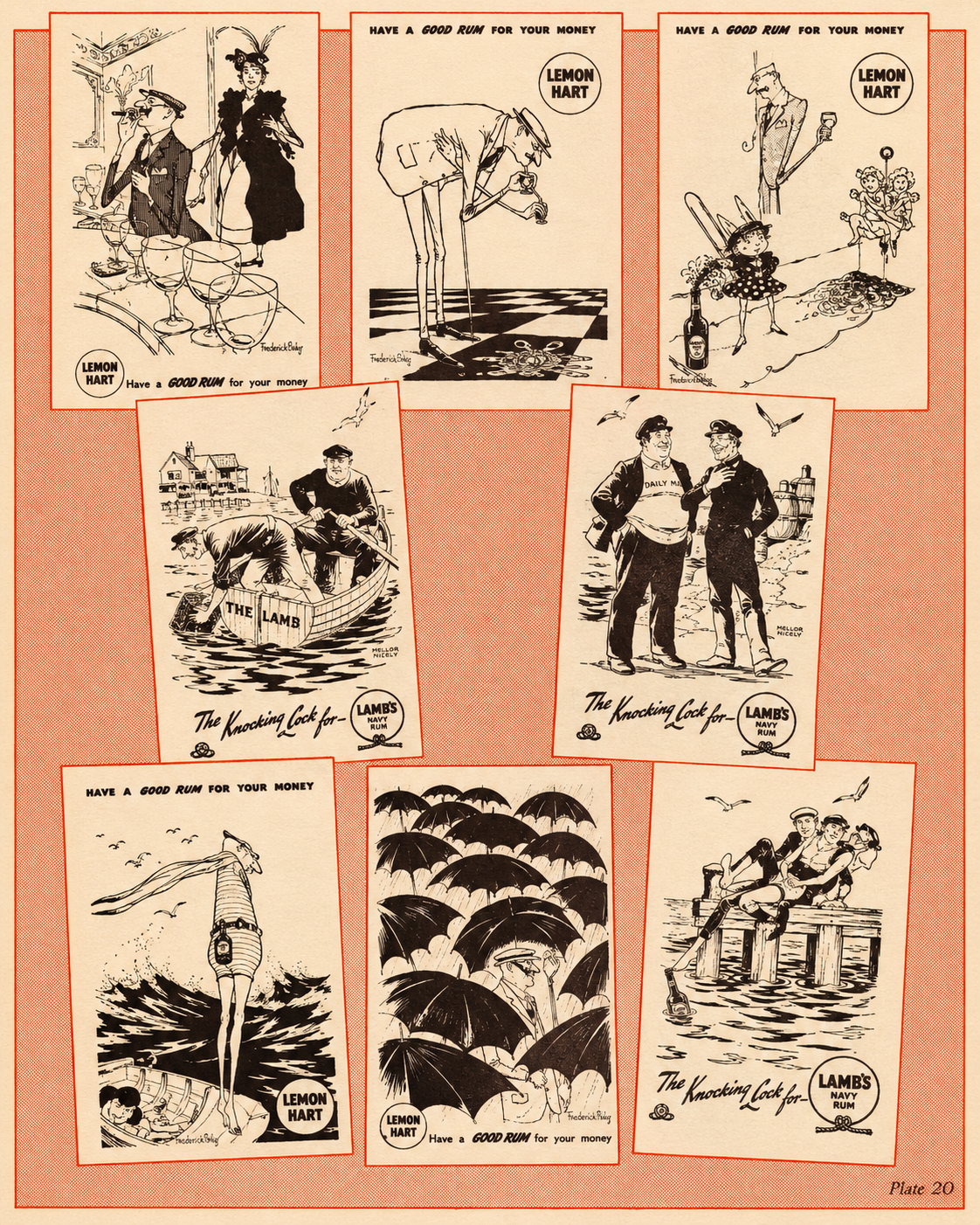
Plate 20 from the booklet Rum: From the Cane to the Consumer (United Rum Merchants, 1951), featuring a selection of advertising illustrations for Lemon Hart and Lamb's Navy Rum. The booklet attributes these drawings to Ronald Searle and Helen McKie.
The booklet reveals the journey of Demerara rums: produced in distilleries associated with the Booker Group's sugar estates, they were shipped in casks to England, notably aboard vessels of the Booker Line. In London, the casks were transferred to vast bonded warehouses, where the rums continued to mature. The booklet refers to ageing periods of at least three years for rums intended for the British market, and sometimes considerably longer for the heavier expressions. At the time, United Rum Merchants claimed to hold more than 34,000 casks in London warehouses, representing some 2.5 million proof gallons.
But it is above all the role of the blender that catches our attention. According to the booklet, rums from different distilleries were tasted and then combined in large vats, following carefully established proportions to recreate the desired profile. Distillates naturally varied from one crop to another, and the blender's task was precisely to maintain a consistent character. The firm even went so far as to bring water from Scottish lochs to reduce its blends to bottling strength, before allowing the water and rum to marry for at least fourteen days. Now there is a detail one would hardly expect to discover behind an old Lemon Hart bottle!
This booklet reveals something essential: Lemon Hart was not based on an unchanging recipe from a single distillery. The firm had inherited a long tradition of selection and blending, enabling it to offer different styles from rums with widely varying characteristics. This is also why it would be misleading to retrospectively attribute all old Lemon Hart Demerara bottles to Demerara Distillers Ltd, a company that was not established until several decades later, in 1983.
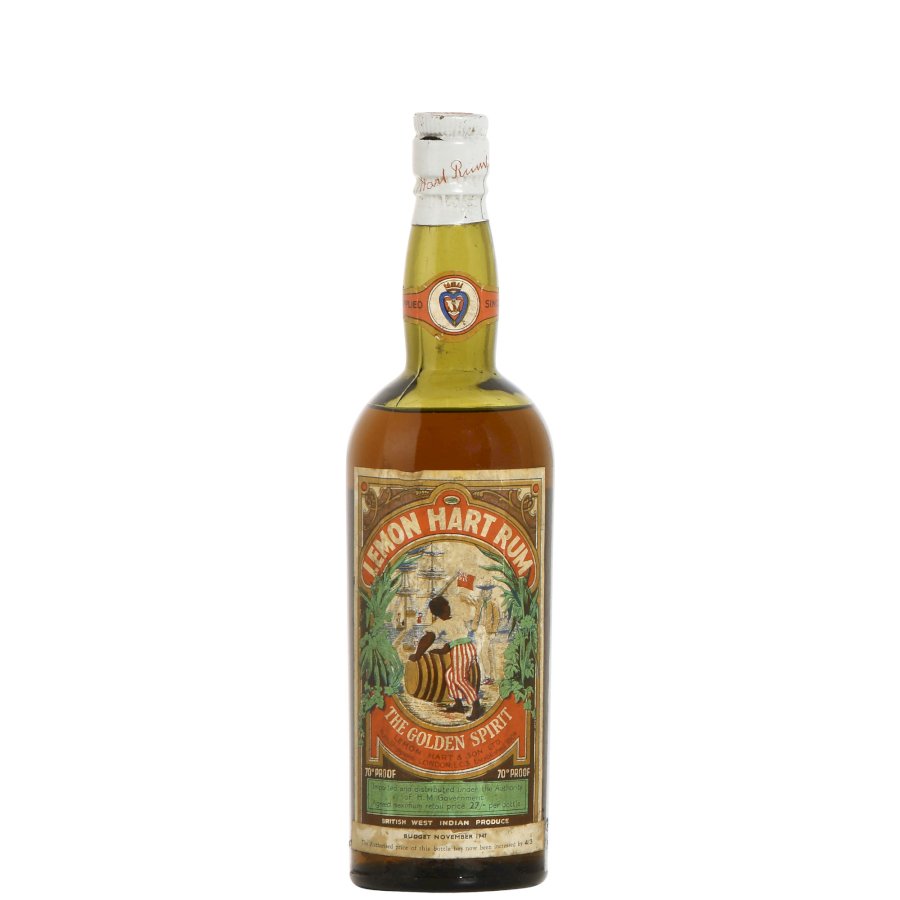
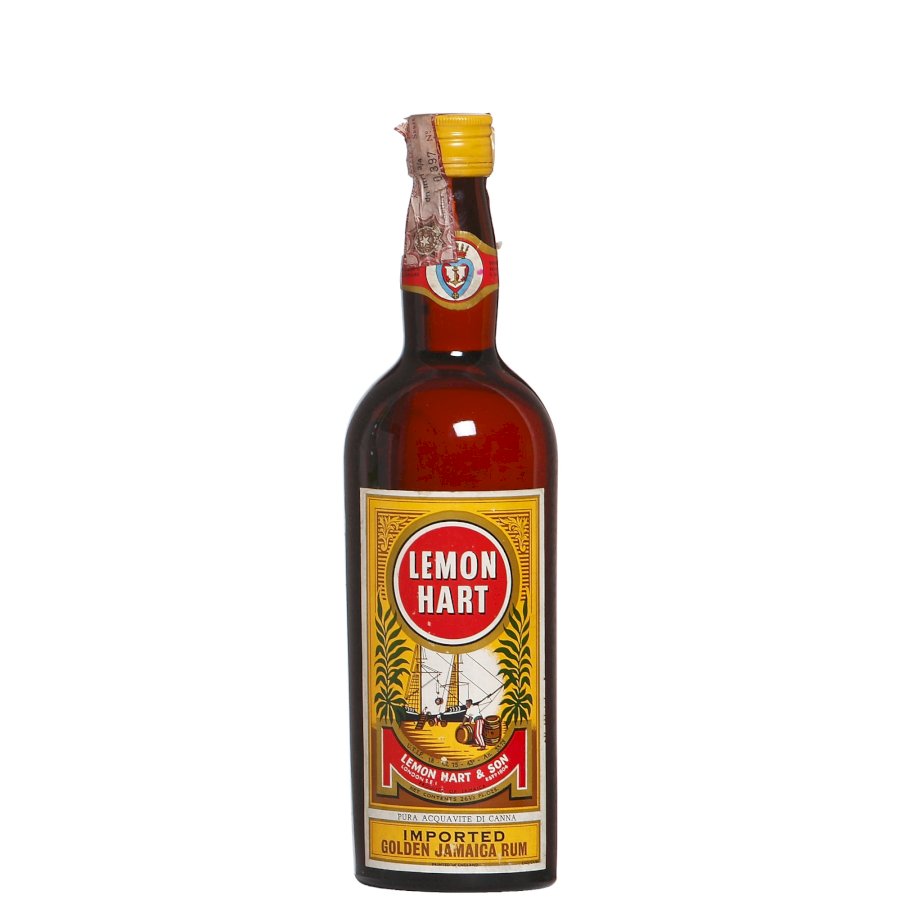
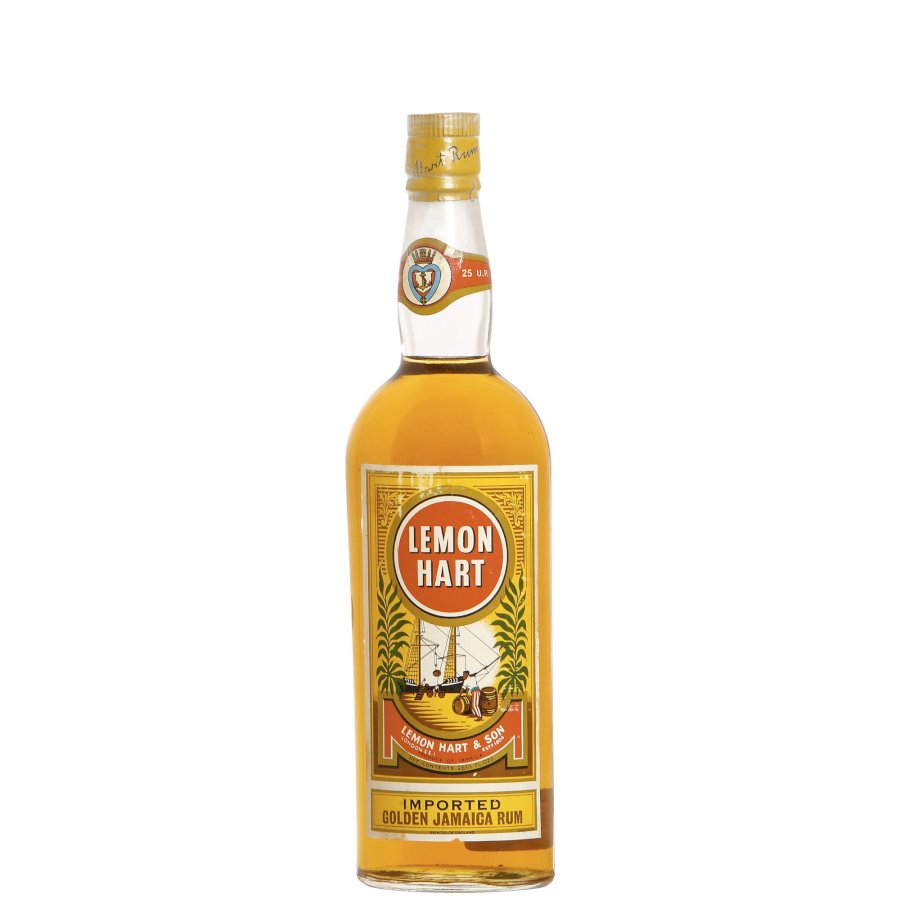
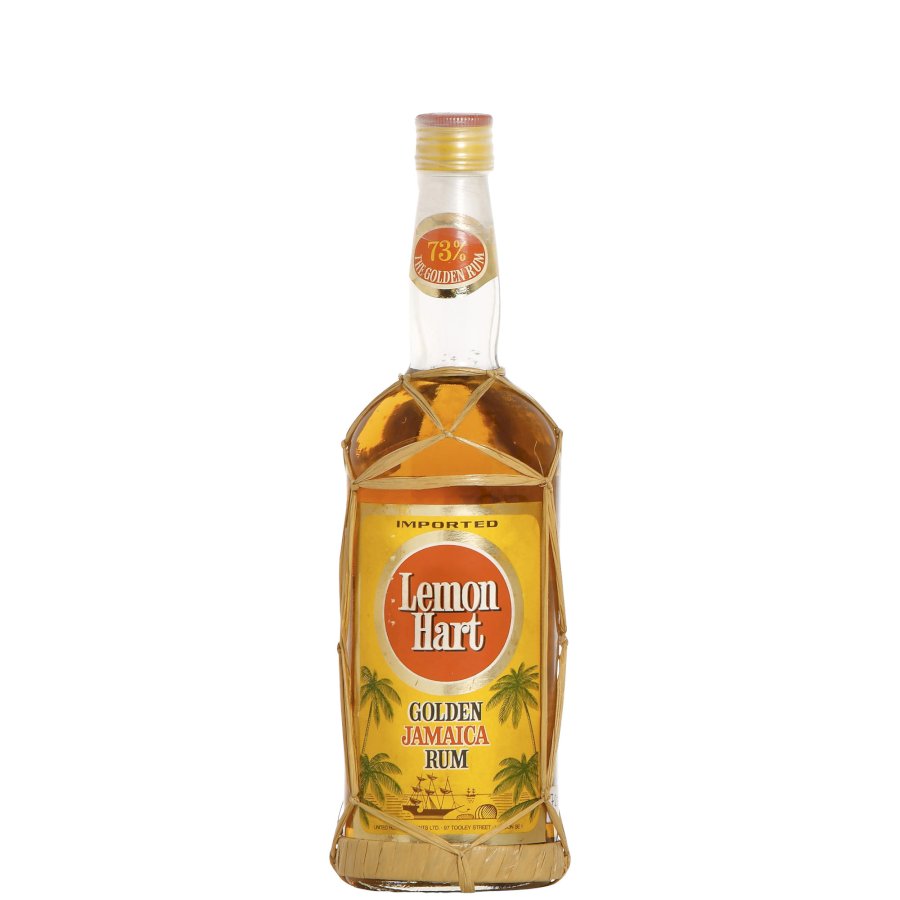
And Jamaican rums did not disappear from the range either. During the 1950s and 1960s, Lemon Hart continued to market a Golden Jamaica Rum, several vintage bottles of which have survived to this day. Some were offered at 40% or 43% ABV, while other expressions intended for different markets displayed considerably higher strengths.
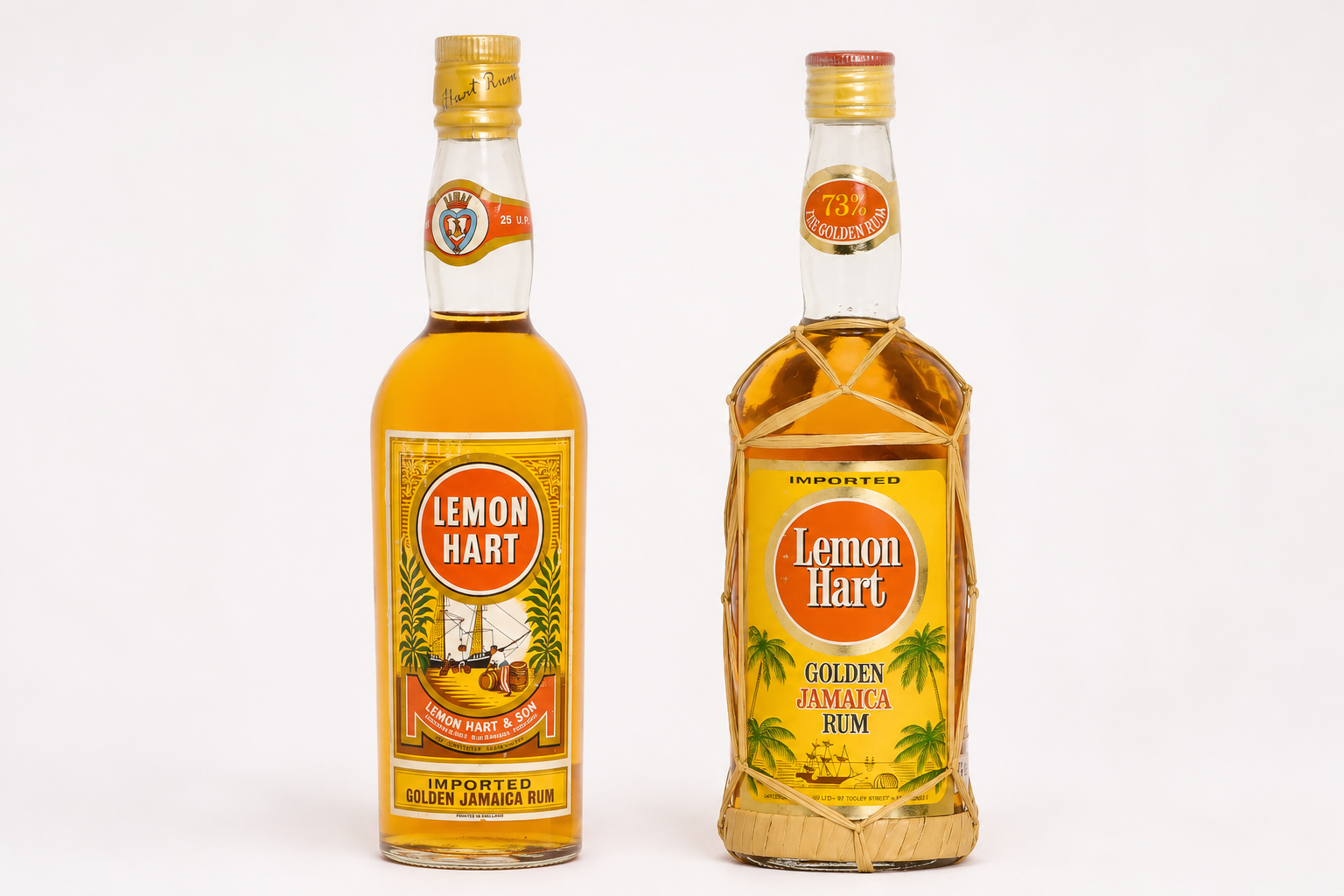
Lemon Hart Golden Jamaica Rum, 43%, a bottling attributed to the 1950s, and Lemon Hart Golden Jamaica Rum, 73%, a bottling from the 1970s–1980s.
Another vintage bottle perfectly illustrates this diversity: a Golden Jamaica bottled at 73% ABV, marketed in Germany by the importer Epikur during the 1970s–1980s (the bottle on the right in the photograph above). At such a high strength, we find once again the tradition of particularly powerful rums that Lemon Hart had already offered in the 19th century, but this time under a label explicitly identifying Jamaica as its origin. Proof, if any were needed, that Lemon Hart's great overproof rums were not necessarily all Demeraras...
From thirty-year-old Jamaican rums to Golden Jamaica, from standard-strength Demeraras to powerful overproof expressions, Lemon Hart offered a far more varied range for many decades than the one generally associated with its name today. And this diversity goes a long way towards explaining the firm's longevity: it was not simply selling a rum, but a selection of rums suited to different markets and different uses.
Yet among all these expressions, one would gradually acquire a status all of its own. An exceptionally powerful Demerara, whose strength would become almost as famous as the brand name itself: 151 proof. And its story will take us far beyond the London warehouses, all the way to the bars of California, where a handful of bartenders were about to revolutionise the art of the cocktail...
Lemon Hart 151, from Demerara to the first tiki cocktails
Of all the expressions marketed by Lemon Hart over the decades, none has left such a lasting impression as the 151 proof. Even today, these three numbers are enough to evoke an exceptionally powerful rum, inseparable from the great classics of tiki culture. But how did a Demerara blend, rooted in the tradition of London rum merchants, become one of the most sought-after ingredients among American bartenders? To find out, we must first understand what this famous 151 really means.
Under the American system, 151 proof corresponds to 75.5% alcohol by volume. But under the old British system, used for centuries to measure the strength of spirits, a rum of this strength would have been described as 32 degrees overproof. The British reference point, known as 100 proof, corresponded to approximately 57.15% alcohol by volume, whereas the American system simply uses a scale twice the alcohol percentage.
And this difference takes us straight back to Lemon Hart's history. Remember that New Zealand advertisement from 1878, which already offered the firm's rums at 12 and 33 degrees British overproof. The stronger of the two reached approximately 76% alcohol! In other words, Lemon Hart was marketing rums of a strength comparable to 151 long before the appearance of this American designation. However, we do not know whether these early expressions shared the same origins and characteristics as the later Demerara 151 rums...
But why exactly 151, rather than 150 proof? Rum historian Matt Pietrek investigated this question and uncovered numerous Canadian advertisements for rums at 32 degrees overproof, some dating back to 1911. The transition to the American designation of 151 proof therefore appears to be a continuation of this older British strength. When rounded, its conversion gives us precisely 151 proof... So it was not necessarily a matter of inventing a new rum, but rather of presenting an already familiar strength in a way that American consumers could understand.
Pietrek's research reveals another surprise: the earliest American advertisement discovered so far for a rum explicitly described as 151 proof concerns the Hudson's Bay Company, in November 1934. For Lemon Hart, the commercial evidence dates back to at least 1937. The British firm was therefore not necessarily the first to use this designation, contrary to what its reputation might suggest. But it would go on to become one of its most famous representatives...
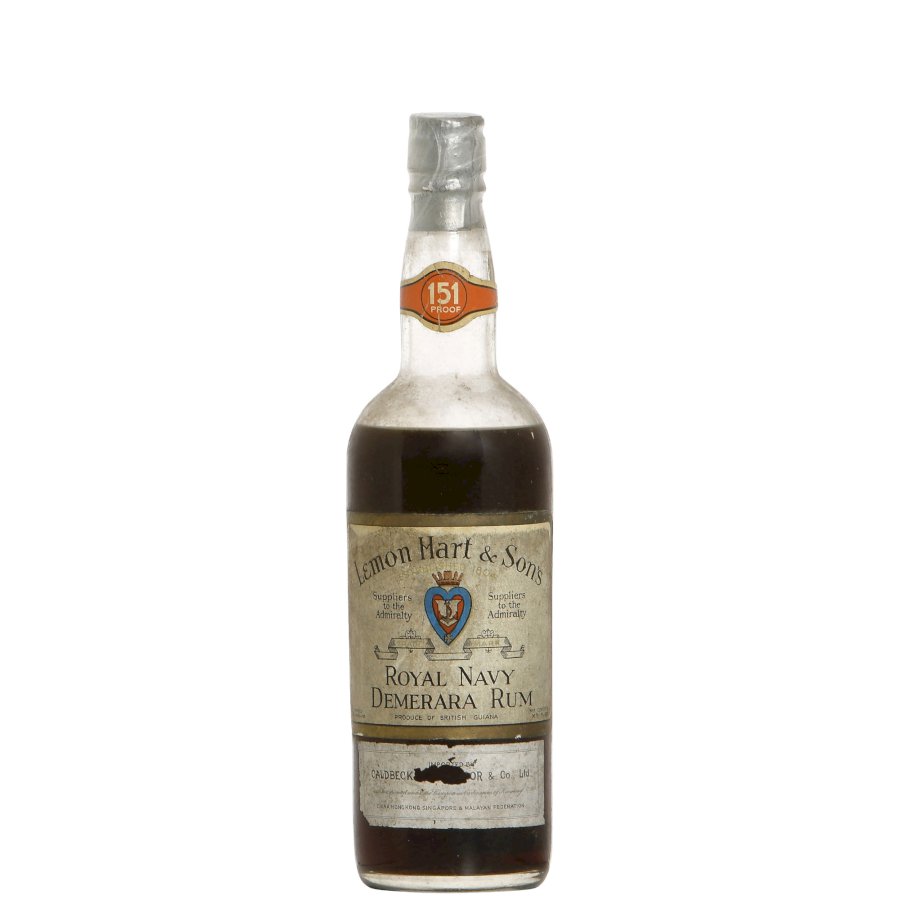
In the years that followed, Lemon Hart Royal Navy Demerara Rum gradually established itself in several markets. Its vintage bottles proudly displayed the words 151 Proof, Produce of British Guiana and sometimes Suppliers to the Admiralty. The reference to the Royal Navy recalled the firm's commercial past, while the Demerara origin emphasised a distinctive style of rum. These labels thus brought together several elements of Lemon Hart's identity: its British heritage, its Guianese blends and its long tradition of particularly powerful rums:
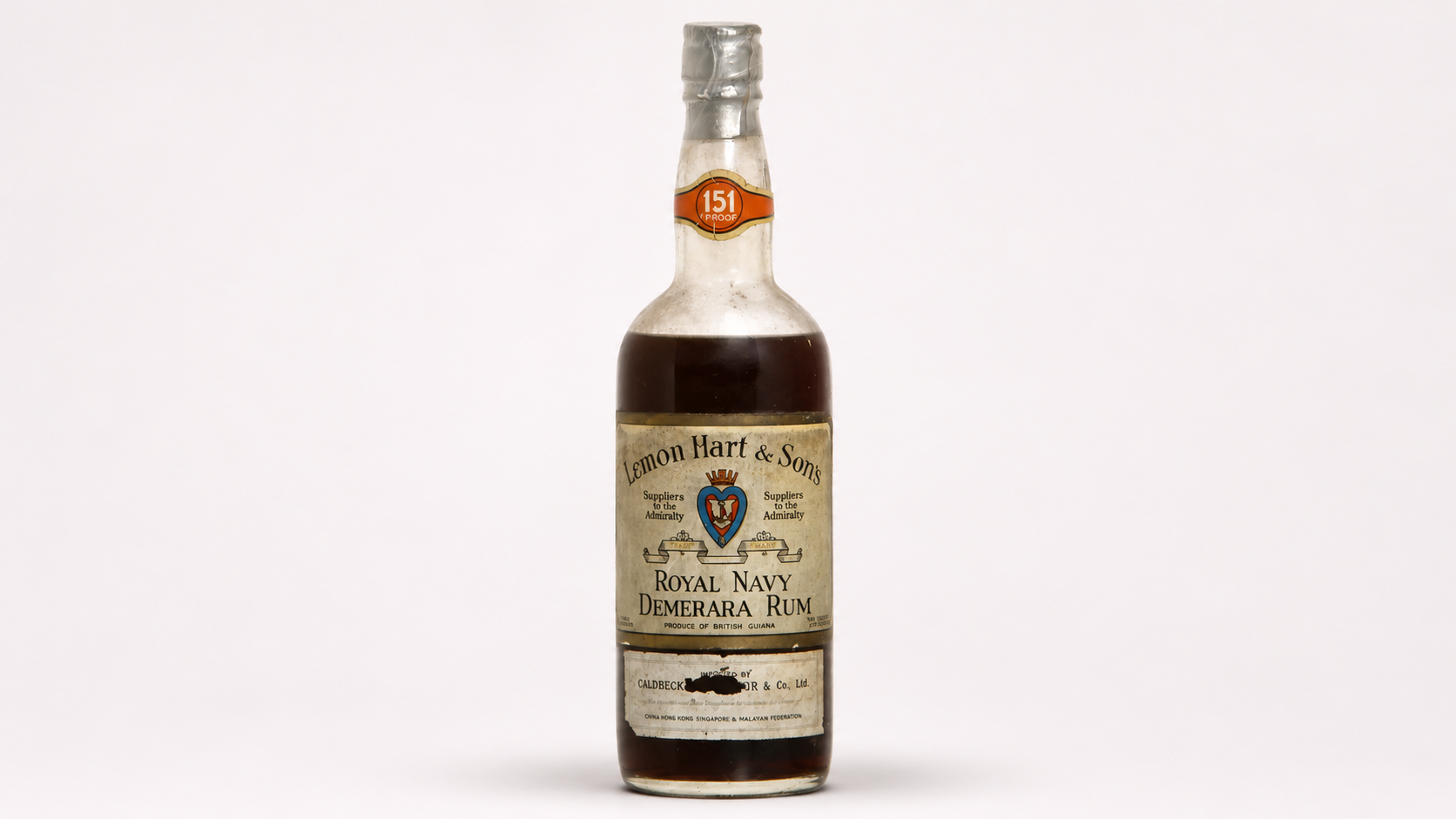
Lemon Hart & Son's Royal Navy Demerara Rum, 151 proof (75.5% ABV), a bottling attributed to the 1940s. Intended for Asian markets, this bottle retains the historic commercial references of the London firm. Photograph: ROW Spirits.
And we know that 151 was far from being the only expression in the Demerara range. In the American Federal Register of 24 May 1945, an official price table lists three products side by side: Lemon Hart Demerara 151 proof, Demerara 114 proof, equivalent to 57% ABV, and Special Dark at 90 proof, or 45% ABV. Three different expressions available on the American market at the same time. Further evidence that Lemon Hart was not simply trying to sell the strongest rum possible, but was offering its customers a range of strengths and styles.
Yet it was the 151 that would ultimately become legendary. And to understand how, we must leave the warehouses of London behind and cross the Atlantic, all the way to Hollywood, California...
In the early 1930s, the United States was just emerging from Prohibition. Bars could once again legally serve spirits, and a new generation of entrepreneurs began imagining establishments that could transport their customers to distant places without ever leaving town. Among them was a particularly colourful character: Ernest Raymond Gantt, who would soon become known as Donn Beach.
After travelling through the Caribbean and the Pacific, Donn Beach opened a small establishment in Hollywood towards the end of 1933, naming it Don's Beachcomber. Its decor was radically different from that of traditional American bars: bamboo, souvenirs from distant travels, fishing nets, lanterns and exotic furnishings immersed visitors in an imaginary tropical paradise. Cocktails took centre stage, and Donn Beach experimented with complex combinations of rums, fruit juices, spices and syrups.
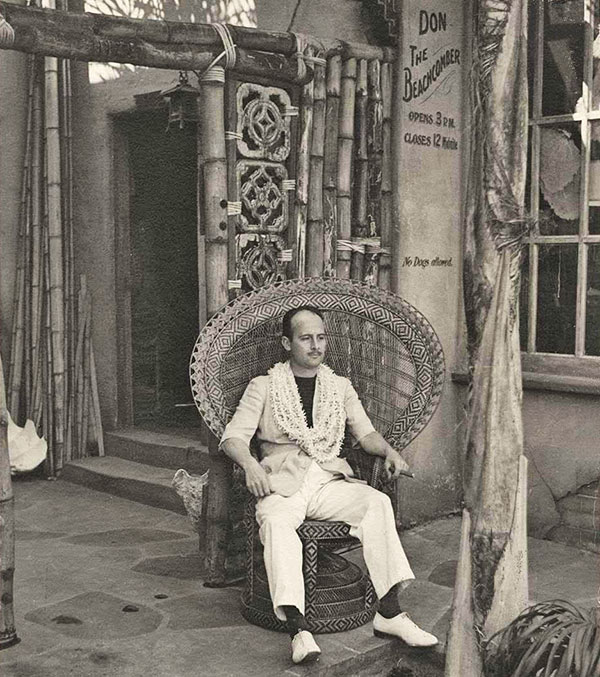
Donn Beach, founder of Don the Beachcomber, photographed outside his Hollywood establishment. A man who would profoundly transform the history of rum cocktails. Archival photograph reproduced by Lost Tables.
And in 1934, Donn Beach created a drink that would achieve extraordinary success: the Zombie. This cocktail bore little resemblance to the ordinary punches of the period. It combined several rums with distinct characters, along with lime juice, spices and carefully measured ingredients. Its reputation quickly spread far beyond Hollywood. Newspaper columnists delighted in commenting on its strength, celebrities flocked to the establishment and, according to the tradition recounted by cocktail historians, Donn Beach limited customers to two Zombies each.
But behind this rather notorious reputation lay a genuine art of blending. Donn Beach was not simply mixing several strong spirits together. He sought to combine rums with complementary flavour profiles. In the historical recipe reconstructed by Jeff "Beachbum" Berry, the Zombie brings together a gold Puerto Rican rum, a Jamaican rum and a 151 proof Demerara. Lime juice, falernum, grenadine, bitters and a few drops of Pernod complete the mixture, along with a mysterious ingredient known as Don's Mix.
Each rum plays an essential role. The Puerto Rican rum provides a relatively light base, the Jamaican rum contributes its distinctive aromatic character, and the Demerara 151 brings additional intensity, capable of standing up to dilution and the richness of the other ingredients. The appeal of such a blend therefore lies in much more than its alcoholic strength alone. For rum enthusiasts, it is also a remarkable demonstration of how different distillation traditions can complement one another in a single glass.
And the story behind this recipe is almost as fascinating as the cocktail itself. Donn Beach guarded his secrets jealously. Some preparations were concealed behind codes, while several bottles used at the bar carried nothing more than numbers, so that employees did not necessarily know what they contained. For decades, competitors tried to recreate the Zombie without ever managing to reproduce the original formula exactly...
It was not until the early 2000s that cocktail historian Jeff "Beachbum" Berry managed to solve much of the mystery. In 2005, he gained access to the recipe notebook of Richard "Dick" Santiago, a former employee of Don the Beachcomber. This small notebook, probably dating back to the 1930s, contained a Zombie recipe marked "old". Berry recognised what might be the original 1934 formula, or something very close to it. But one ingredient still needed to be deciphered: the famous Don's Mix, itself made from grapefruit juice and a secret preparation called Spices #4. Thanks to the testimony of a former bartender, Berry eventually discovered that this was a cinnamon syrup. The Zombie recipe could finally be reconstructed and published in his book Beachbum Berry's Sippin' Safari, released in 2007.
And among the rums recommended by Berry to recreate the balance of this historic recipe is none other than Lemon Hart 151 Demerara. One important distinction must nevertheless be made: the old notebook documents the use of a 151 proof Demerara, while the specific identification of Lemon Hart in the 1934 formula is partly based on Berry's reconstruction and subsequent research. The surviving sources do not allow us to establish with certainty the brand of every bottle used in the very first Zombie. But this in no way diminishes Lemon Hart's historical importance in tiki culture.
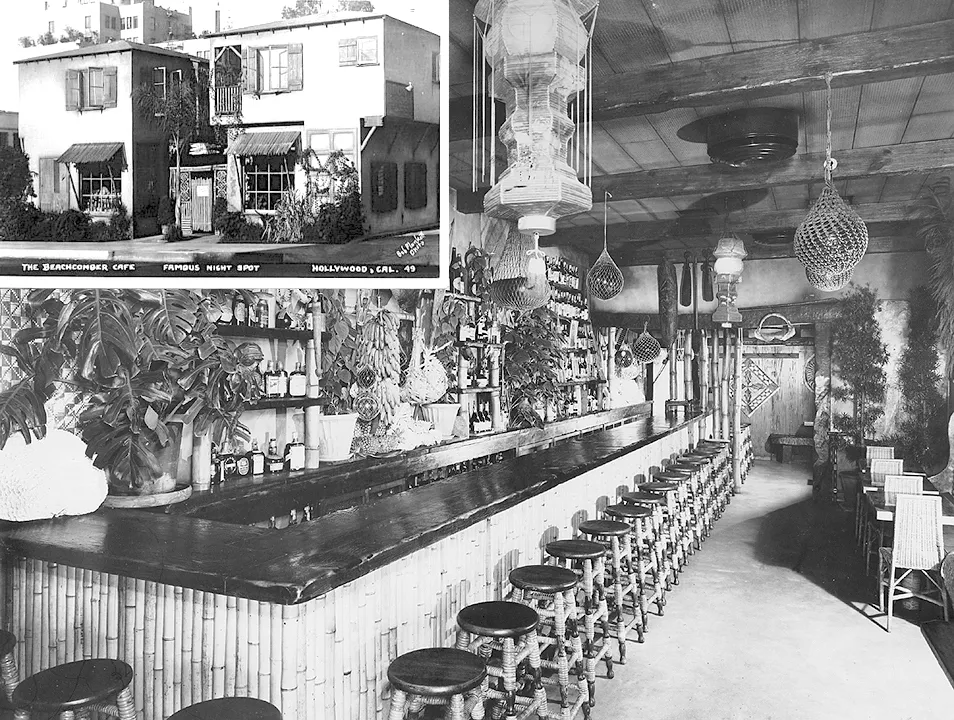
The interior of Don the Beachcomber at 1727 North McCadden Place, Hollywood. Bamboo, lanterns and a tropical bar counter: a setting that became emblematic of the earliest tiki establishments. Period photograph reproduced by Martin Turnbull.
The Zombie was not the only cocktail to contribute to the reputation of 151 proof rum. Donn Beach and his successors developed other recipes featuring overproof Demerara rums, including the famous 151 Swizzle. This cocktail, combining powerful rum with lime juice, sugar, bitters and a hint of anise, would be adopted and adapted by several historic establishments, including the Mai-Kai in Fort Lauderdale from the 1950s onwards, followed by Tiki-Ti in Los Angeles in the early 1960s.
A new rum culture was emerging. In tiki bars, spirits were no longer chosen simply according to their general origin or alcoholic strength. Certain recipes called for very specific styles, and sometimes even particular brands. For bartenders seeking to recreate the flavours of classic cocktails, a 151 proof Demerara was not necessarily interchangeable with a lighter 151 produced in Puerto Rico. The rum's origin and aromatic character mattered just as much as its strength.
After the Second World War, tiki culture experienced spectacular growth in the United States. Polynesian-inspired establishments multiplied, recipes circulated and tropical cocktails became a genuine craze. Other producers began marketing their own 151 proof rums, particularly in the Caribbean and Puerto Rico. Lemon Hart was therefore no longer alone in this market, but its name remained closely associated with the tradition of Demerara overproof rum.
There is something quite extraordinary about this evolution: just a few decades earlier, Lemon Hart had been selling its rums to merchants and distributors throughout the British Empire, while also supplying certain shipments to the Royal Navy. Now, it was behind the counters of American bars that its name was building a new reputation. Gradually, 151 proof became much more than an indication of alcoholic strength: it became a true benchmark for enthusiasts of classic cocktails.
And yet, this fame would almost overshadow part of the firm's history. The old Jamaican rums aged seventeen, twenty-eight or thirty years, the other Demerara expressions and the numerous blends that had once made up the Lemon Hart range gradually faded into the background. For generations of enthusiasts, the name of an old merchant family became almost synonymous with Demerara 151.
But while this rum was conquering American bars, Lemon Hart bottles continued their journey around the world. From New Zealand to Asia, from Canada to European markets, the firm developed a remarkably extensive commercial presence. And its vintage advertisements, labels and even its surprising illustrated characters still have a few wonderful discoveries in store for us...
Lemon Hart, a name that travelled the world
From Penzance to the warehouses of London, from shipments destined for the Royal Navy to the first tiki bars of Hollywood, we have already travelled quite a distance in the company of Lemon Hart. But while its famous 151 proof was building a reputation among American cocktail enthusiasts, the British firm was continuing a commercial adventure that had begun much earlier. For Lemon Hart rums had been travelling around the world for decades, sometimes reaching the most unexpected places. And today, vintage advertisements, commercial records and surviving bottles allow us to retrace some of the stops along the way.
Take New Zealand, for example. On 12 April 1873, in the pages of Wellington's Evening Post, a merchant named Krull & Co. published a lengthy list of goods offered for sale. Among them were tea, coffee, spices, French wines, cognacs, whiskies... and, almost inconspicuously, twenty quarter-casks of Lemon Hart rum. Just another commercial advertisement, perhaps, but one that confirms the brand's presence on the other side of the world as early as the second half of the 19th century.
Ten years later, in the Evening Star of Dunedin, dated 6 June 1883, Lemon Hart was the subject of a dedicated advertisement. It offered the firm's rums in casks and quarter-casks, as well as two bottled expressions: Finest Old Jamaica and Royal Navy Rum. But one detail particularly catches our attention. The advertisement advised buyers to make sure that every case and cask bore the full name Lemon Hart and Son, London. A warning intended to protect the original brands against imitations or commercial confusion:
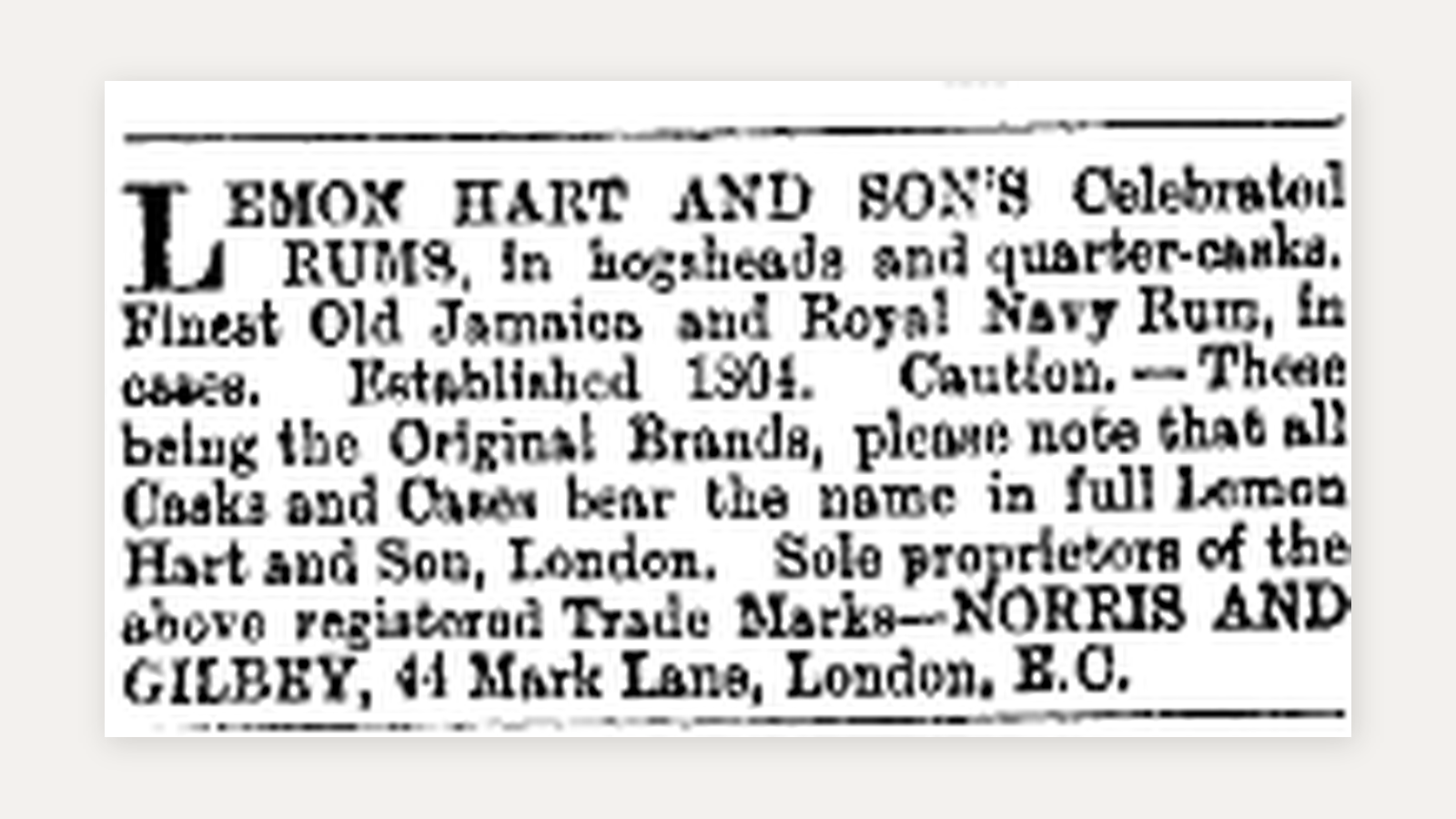
And this advertisement holds another surprise: the proprietors of the brands were identified as Norris & Gilbey, at 44 Mark Lane, London. We are now a long way from the small family business in Penzance! The Lemon Hart name continued to travel, but behind it, different London merchant houses were now taking over. The continuity of the brand did not necessarily mean continuity of ownership.
This evolution becomes even clearer in an official document dated 13 September 1900. In the New Zealand Gazette, the firm Portal, Dingwall & Norris, established at 40 Eastcheap, London, applied to register the trademark Lemon Hart & Son, London. The applicants declared that they had been using it for twenty-five years and sought to protect it across several categories of spirits, including rum, gin, whisky and brandy. Further evidence that Lemon Hart had become a genuine commercial asset, whose name held value far beyond the bottles themselves.
But the journey did not end in the Pacific. In Asia, major European wine and spirits merchants had also established extensive distribution networks, supplying hotels, clubs, traders and foreign communities in the principal ports. And one of these companies would play an important role in distributing Lemon Hart rums: Caldbeck, Macgregor & Co.
Founded in Shanghai in 1864, this British firm gradually established itself as a major player in the wine and spirits trade in the Far East. It opened a branch in Hong Kong in 1889, before expanding its operations to Singapore, Tianjin and numerous Chinese ports. In 1908, an imposing volume devoted to the commercial communities of Hong Kong and Shanghai, Twentieth Century Impressions of Hongkong, Shanghai, and other Treaty Ports of China, devoted several particularly interesting paragraphs to the company.
The book describes Caldbeck, Macgregor's offices, warehouses and even its bottling department in Hong Kong. The firm also maintained important commercial relationships with hotels, clubs and visiting military vessels. According to the publication, it had supplied more than 150 British warships since 1878, along with numerous American naval vessels. These figures concern the entire range of wines and spirits distributed by Caldbeck, Macgregor, rather than Lemon Hart specifically. Nevertheless, they give us some idea of the scale of this commercial network.
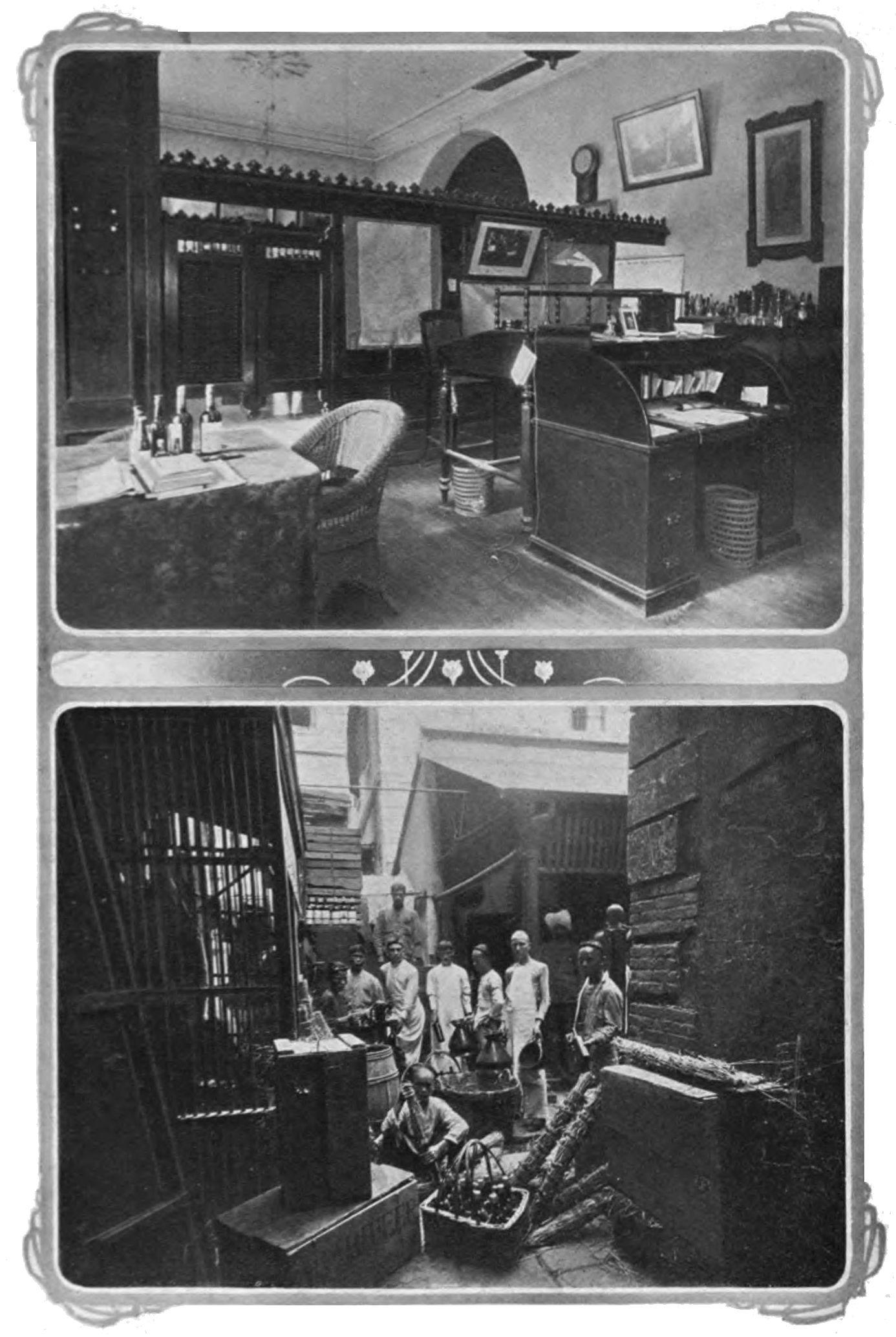
The offices and bottling department of Caldbeck, Macgregor & Co. in Hong Kong, 1908. Original photographic plate published in Twentieth Century Impressions of Hongkong, Shanghai, and other Treaty Ports of China, edited by Arnold Wright.
And now, surviving vintage bottles provide confirmation of this commercial relationship. Certain Lemon Hart Royal Navy Demerara Rum 151 proof bottlings, attributed to the 1940s, bear the name Caldbeck, Macgregor & Co. Ltd. as importer for several Asian markets: China, Hong Kong, Singapore and the Federation of Malaya. Far from the shores of British Guiana, where their rum had been produced, these bottles were destined for the distribution network of a merchant house that had been established in Asia for generations.
But that is not all. In September 2019, the auction house Whisky.Auction presented a truly remarkable collection: eleven Lemon Hart bottles from the 1940s, which had remained in the cellar of the same family for decades. Their owner, Charles Metcalfe, explained that he had inherited them from his father, who had worked for Lemon Hart & Sons between 1946 and 1948, following his return from a prisoner-of-war camp. His father had kept the bottles as mementos of his time with the company.
And these eleven bottles were not all identical! The collection included seven Lemon Hart 151 Proof Royal Navy Demerara Rums, imported by Caldbeck, Macgregor for Asian markets, but also four Overproof Royal Navy Demerara Rums featuring a different presentation. Yet another illustration of Lemon Hart's commercial diversity, with expressions that could vary according to the markets and distribution channels...
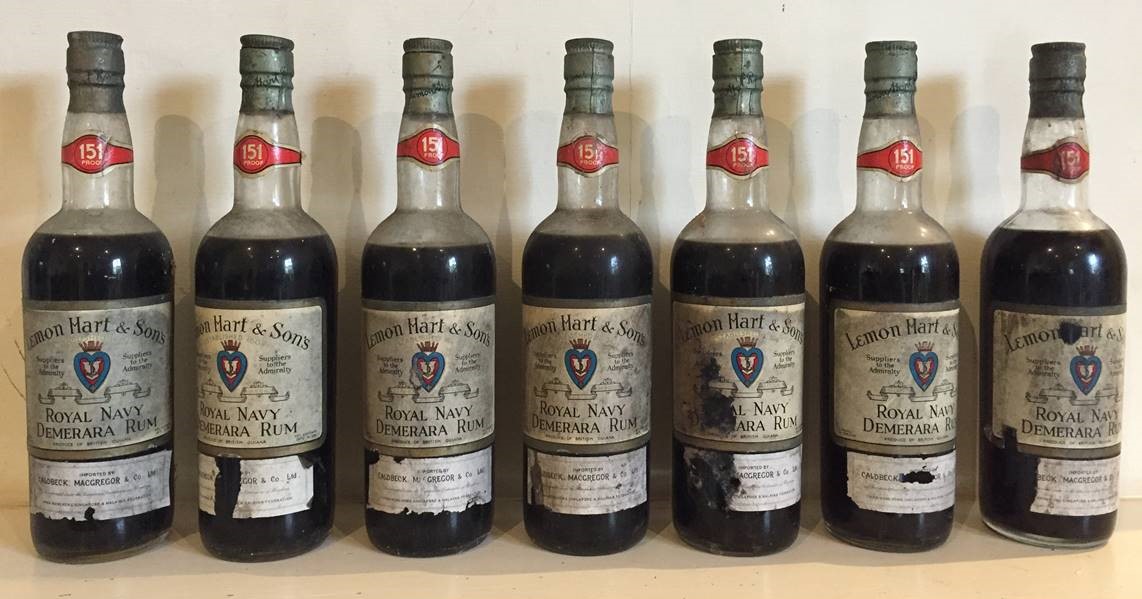
Seven Lemon Hart 151 Proof Royal Navy Demerara Rum bottles from the 1940s, originating from the Metcalfe family collection. Intended for Asian markets, these bottles bear the name Caldbeck, Macgregor & Co. Ltd. Original photograph: Whisky.Auction, September 2019.
Other archives allow us to continue our journey. On 5 June 1953, the Ceylon Government Gazette published an official list of rums imported in bottles into Ceylon, now Sri Lanka. Among the authorised brands was a Lemon Hart V.O. Jamaica Rum, associated with Portal, Dingwall & Norris and with Jamaica identified as its country of manufacture. Even at this time, when Demerara 151 was already enjoying considerable success in certain markets, Lemon Hart was therefore continuing to distribute its Jamaican rums in other parts of the world.
This diversity was also evident on the other side of the Atlantic. In Canada, Lemon Hart developed a significant advertising presence, particularly highlighting its Demerara and Jamaica expressions. In the June 1961 issue of Canadian Homes, an advertisement entitled "The Rum Merchant of Penzance" featured a sailing ship and recounted the origins of the firm's trading activities. It notably claimed that shipments of rum had been arriving in Penzance as early as 1781, before recalling the long-standing reputation of the Lemon Hart name:
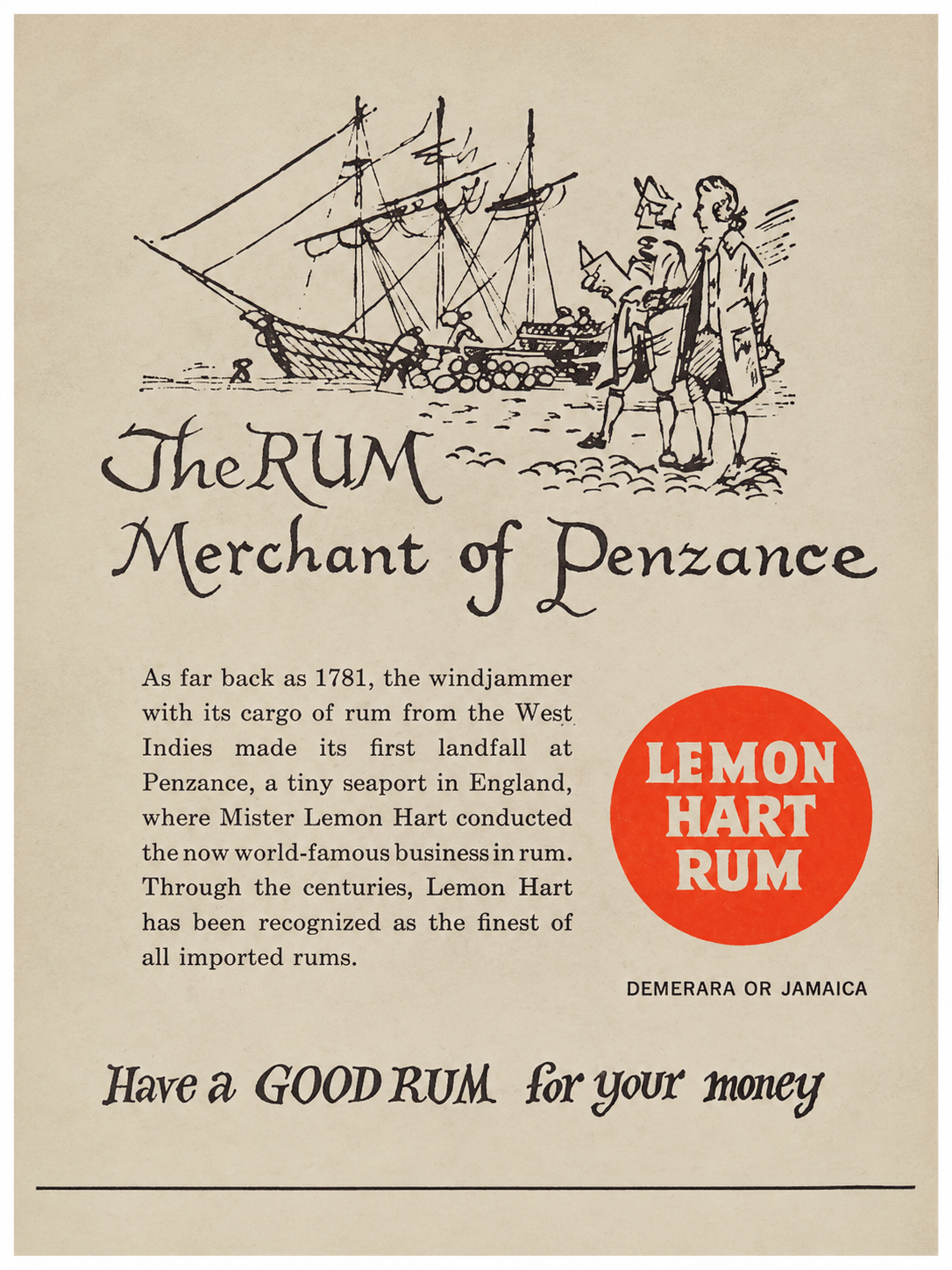
This advertisement is particularly revealing. In 1781, Lemon Hart himself was only thirteen years old! The advertisement therefore blends the beginnings of the family business with the figure of the man who would give his name to the brand. Here we encounter a rather fascinating phenomenon: over time, the history of the Hart family gradually evolved into a commercial legend. The merchants of Penzance became characters in an advertising narrative, whose historical details were sometimes simplified to make a stronger impression on consumers.
But it was in Great Britain that Lemon Hart would undergo a genuine advertising revolution in the mid-20th century. Following its integration into the United Rum Merchants group, alongside brands such as Lamb's Navy Rum, the firm benefited from considerable promotional resources. The professional booklet published by the group around 1951 describes enormous billboards, newspaper advertisements and even an illuminated animated sign in Piccadilly Circus, in the heart of London. A spectacular presence for a brand whose story had begun in a small Cornish port...
And to give its rums a recognisable face, United Rum Merchants turned to one of the greatest British cartoonists of his generation: Ronald Searle. Born in Cambridge in 1920, the artist had become particularly well known for his press illustrations and his instantly recognisable characters. From 1951 onwards, he contributed to advertising campaigns for Lemon Hart and Lamb's Navy Rum, a collaboration that would continue for more than a decade.
His idea was as simple as it was brilliant: to turn the two brands into characters. Mr Lemon Hart became a tall, thin, elongated gentleman dressed in a lemon-yellow suit, while Mr Lamb took the form of a short, round, stocky figure dressed in navy blue. Their contrasting silhouettes gave rise to countless humorous situations, in which the two companions appeared sometimes as allies, sometimes as rivals, but always instantly recognisable.
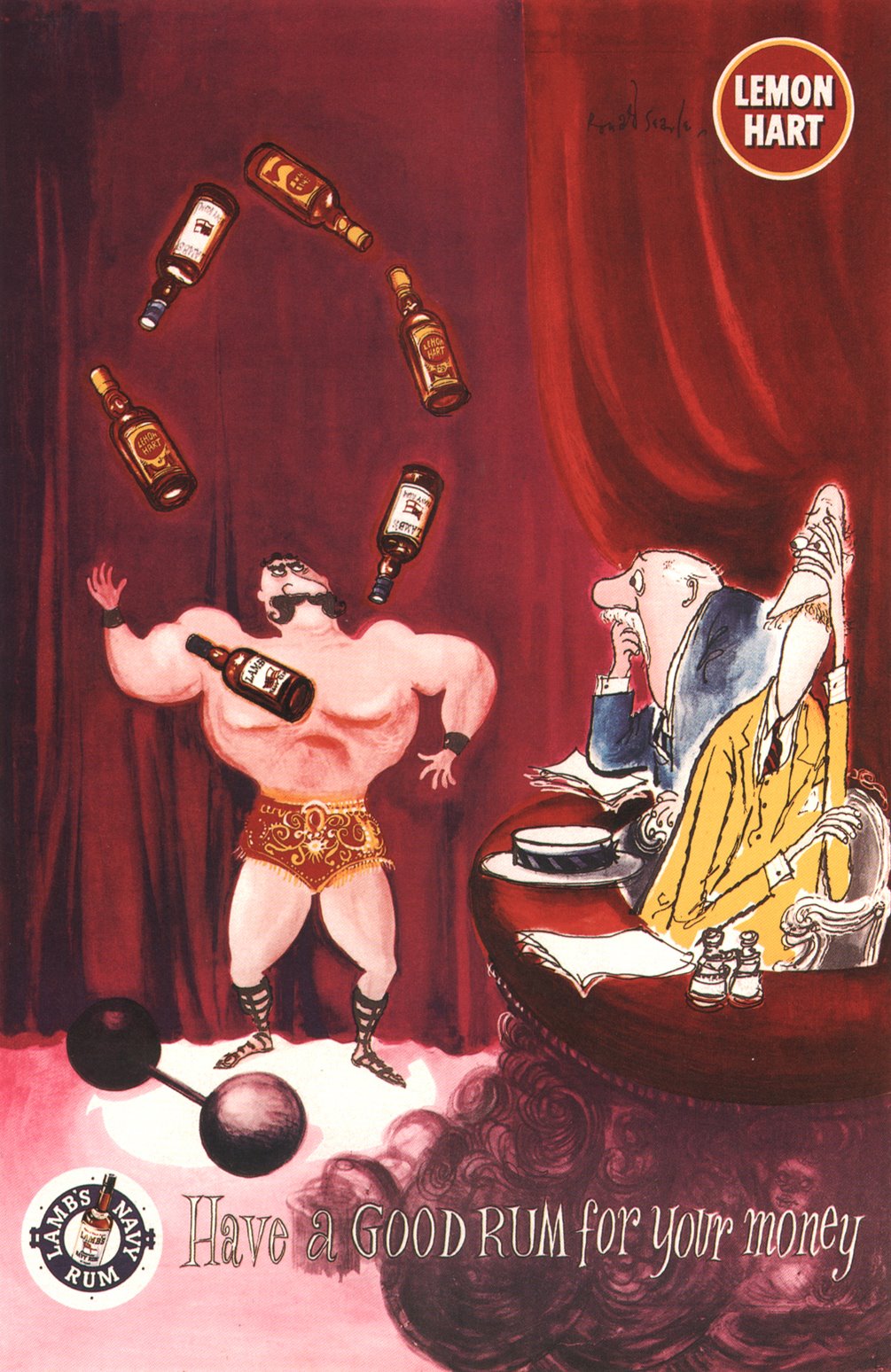
An original advertisement illustrated by Ronald Searle for Lemon Hart and Lamb's Navy Rum in the mid-20th century. Humour and illustrated characters became essential elements of the two brands' identities. Document reproduced by Ronald Searle Tribute.
The slogan "Have a Good Rum for Your Money" accompanied many of these campaigns. The illustrations appeared in newspapers and magazines, but also on posters, beer mats, calendars, promotional items and even monumental billboards. Near Monument, in the heart of the City of London, an enormous Ronald Searle illustration occupied several storeys of a building. Just imagine Londoners discovering this lemon-yellow character amid the traffic, buses and buildings of the capital!
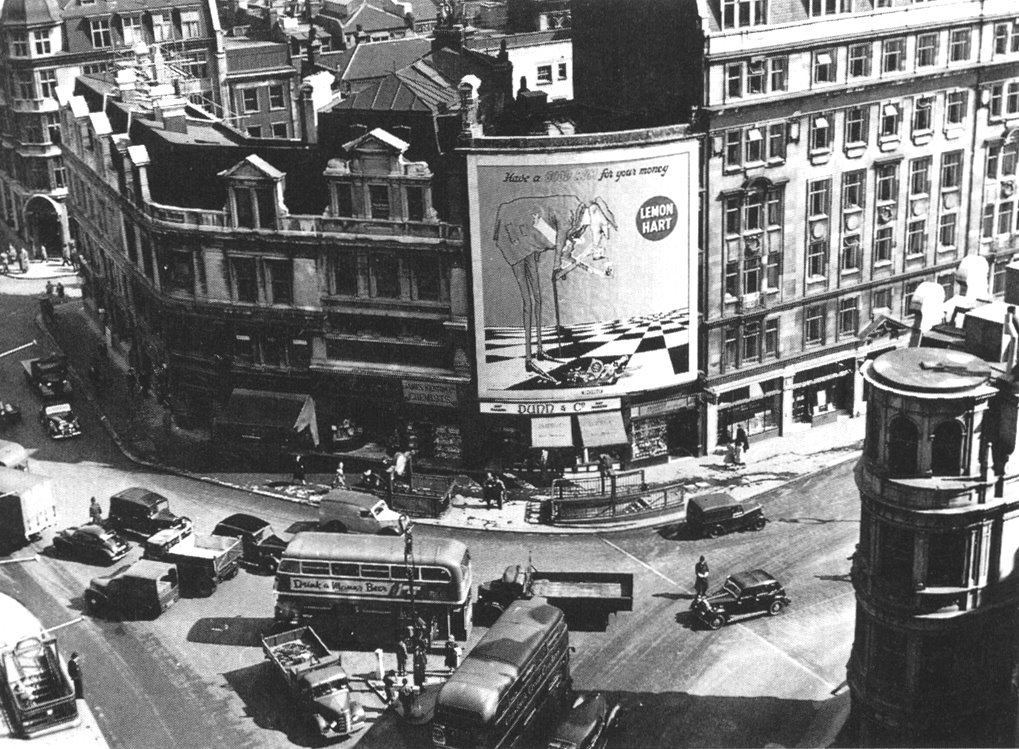
A giant Lemon Hart billboard illustrated by Ronald Searle, photographed near Monument in London during the mid-20th century. The brand's character occupied several storeys of a building. Historical photograph published by Ronald Searle Tribute.
And Searle's characters did not remain confined to paper... In 1958, they even inspired an extraordinary animated advertising short entitled Warm Friends. Created using puppets, this two-minute film tells the story of a skater who falls through the ice into freezing water, before eventually being warmed up with rum. The animation was entrusted in particular to Cor Icke, with puppets created by Harry Tolsma. The film ends with the appearance of Lemon Hart and Lamb's Navy Rum bottles, accompanied by their slogan. An advertisement that perfectly illustrates the inventiveness United Rum Merchants employed to popularise its brands. And here's a little treat for you:
The contrast with Lemon Hart's beginnings is striking. A century earlier, the firm had promoted its rums through small commercial advertisements, specifying the available formats and encouraging buyers to verify the authenticity of its brands. Now it had its own characters, slogans, international campaigns and even advertising films. Lemon Hart was no longer simply the name of a merchant: it had become a genuinely popular brand.
And yet, behind this advertising success, another story was continuing to unfold. While Ronald Searle's characters were making consumers smile, the companies that owned Lemon Hart were undergoing further transformations. The old merchant houses merged, major groups took over and supply chains evolved. As for the rums themselves, their origins and blends did not necessarily remain unchanged over the decades.
From Wellington to Hong Kong, from Ceylon to London, the archives reveal a brand capable of adapting to very different markets and audiences. But they also leave us with one essential question: if the Lemon Hart name has survived across continents and generations, what became of the rum that lay behind its labels?
Lemon Hart today: what remains of the rum of the past?
We have followed Lemon Hart from the quays of Penzance to the tiki bars of Hollywood, rediscovered its early merchants, its old Jamaican rums and even the characters imagined by Ronald Searle. But one question remains: what became of the rum that lay behind those labels? For although the Lemon Hart name has survived for centuries, the companies that owned it, the distilleries that supplied it and the methods used to produce its rums have undergone profound transformations.
Let us return for a moment to the middle of the 20th century. In 1948, Lemon Hart joined several other major British rum houses, including Lamb's and White Keeling, within United Rum Merchants. The following year, the group came under the control of Booker Brothers, McConnell & Co., a company with substantial sugar and rum interests in British Guiana. This development was far from insignificant: Booker owned plantations, production facilities and its own shipping networks to the United Kingdom. Lemon Hart now belonged to a group capable of controlling a large part of the rum supply chain.
The professional booklet published by United Rum Merchants in 1951, which we have already explored, provides valuable insight into this organisation. Rums from Jamaica and Demerara were shipped in casks to England, stored in London warehouses, then selected and blended according to the desired characteristics. At the time, the group reported holding tens of thousands of casks in stock. Above all, however, the work of its blenders made it possible to maintain a certain consistency, even as the available distillates changed from one year to the next.
This is an essential distinction when trying to understand Lemon Hart: the continuity of a brand does not necessarily imply that of an unchanging recipe. At different times, blends may evolve according to available stocks, producers, ageing practices and the markets for which they are intended. One old bottle of Lemon Hart Demerara is therefore not automatically identical to another, even if both carry the firm's famous red emblem...
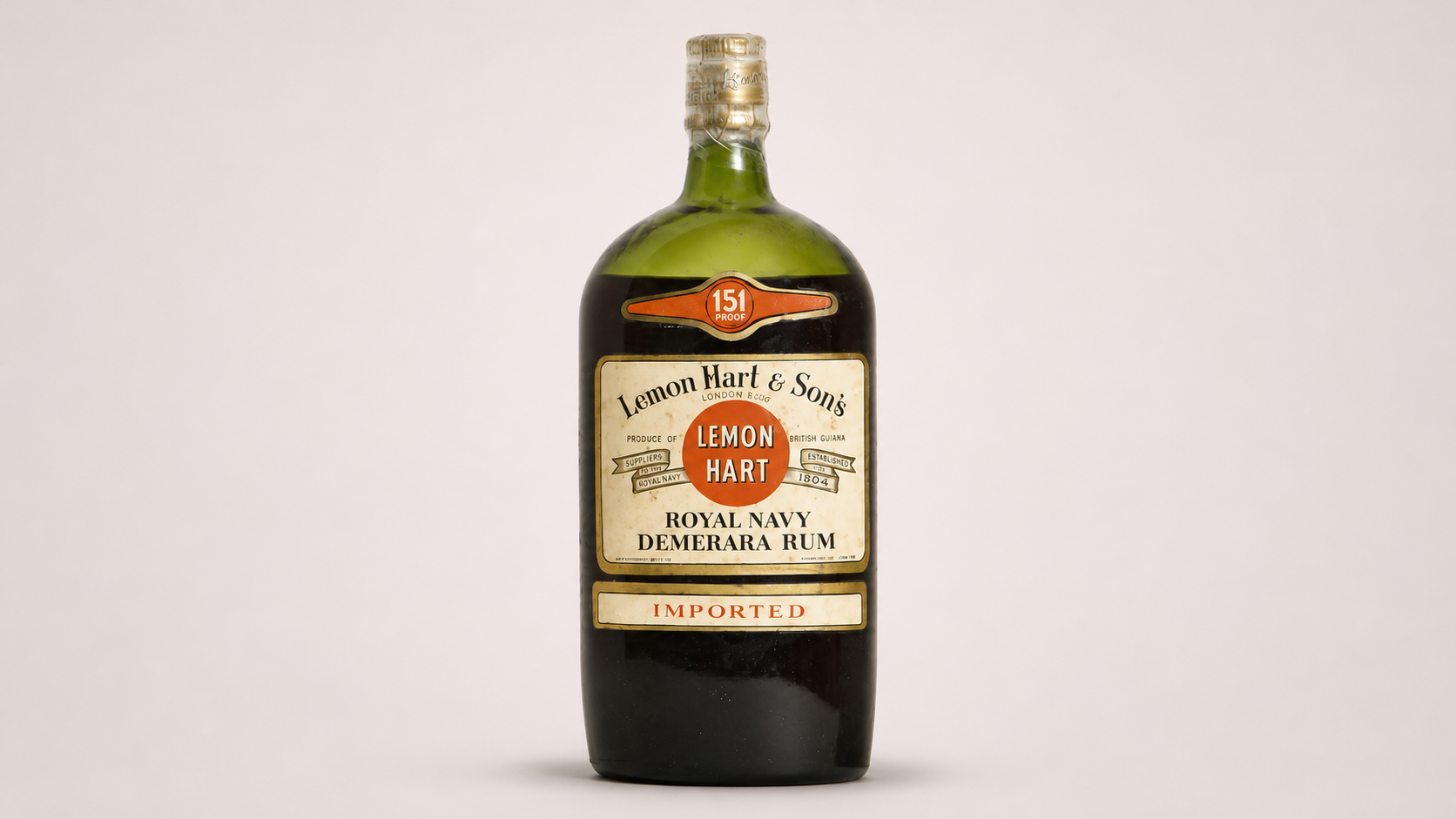
Lemon Hart & Son's Royal Navy Demerara Rum, 151 proof (75.5% ABV), a bottling attributed to the 1960s in a large 114 cl format. A presentation characteristic of the firm's British period. Photograph: ROW Spirits.
Meanwhile, in Guyana, the distilling landscape was changing radically. In earlier times, the Demerara region had been home to numerous plantations with their own distilling facilities. But consolidation continued throughout the 20th century. Following Guyana's independence in 1966, the industry underwent further restructuring, culminating in the creation of Demerara Distillers Limited (DDL) in 1983, through the merger of Guyana Distilleries Limited and Diamond Liquors Limited.
The consolidation of distilleries continued for several more years: Enmore closed in 1994, followed by Uitvlugt towards the end of the decade. In 2000, production from the former distilleries was finally brought together at Diamond, on the eastern bank of the Demerara River. But this centralisation did not mean that all the traditional skills and techniques of the past had disappeared. Several historic stills were preserved, dismantled and reinstalled within the new facilities.
For rum enthusiasts, their names have become almost legendary: Port Mourant, with its double wooden pot still, Versailles, with its single wooden pot still, and Enmore, whose remarkable wooden Coffey column still dates back to the late 19th century. Alongside them, Diamond's metal column stills and the old Savalle columns make it possible to produce other styles of rum, with profiles ranging from lighter and more delicate to powerful and intensely aromatic.
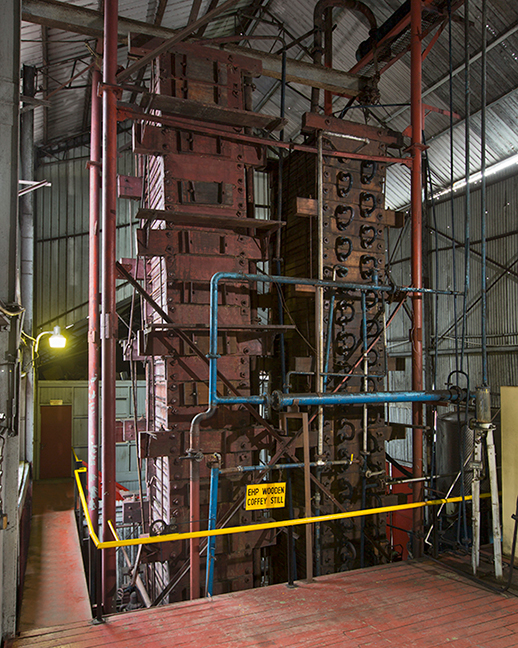
The historic Enmore wooden Coffey still, now installed at Diamond Distillery in Guyana. Built in the late 19th century, it illustrates the preservation of historic distilling equipment within Demerara Distillers Limited. Photograph: Hawaii Beverage Guide.
This technical diversity is essential to understanding modern Demerara rums. A single distillery can now produce several styles that were once associated with different establishments. Nevertheless, it would be tempting, but misleading, to claim that a particular vintage Lemon Hart necessarily originated from Port Mourant, Enmore or Versailles. Without knowing the precise distillation marks and the proportions used in each blend, it is impossible to reconstruct the contents of a historic bottle with certainty. And while the preservation of these stills is an extraordinary achievement, it does not, in itself, guarantee an exact reproduction of the recipes of the past.
Lemon Hart also underwent profound changes on the commercial side. In 1984, Booker sold its rum interests to Allied-Lyons. Five years later, Lemon Hart and Lamb's were brought together with Tia Maria within a new commercial structure, Alfred Lamb International. Then, in 1994, the merger of Allied-Lyons and Pedro Domecq gave rise to Allied Domecq, which was itself acquired by Pernod Ricard in 2005.
Through these successive acquisitions, Lemon Hart changed ownership several times, but continued to be marketed. Its visibility, however, varied considerably from one country to another. In Canada, the brand retained a certain reputation among rum enthusiasts. In the United States, its famous 151 gradually became a sought-after reference among tiki cocktail aficionados, although its distribution was not always consistent.
Strangely enough, however, towards the end of the 2000s, just as tiki culture was experiencing a genuine revival, Lemon Hart 151 became increasingly difficult to find on the American market. Enthusiasts were rediscovering Donn Beach's recipes, bartenders were searching for the historic ingredients, yet one of the most iconic rums used in those cocktails was becoming scarce... On 18 February 2010, an official press release announced a major development: the Canadian company Mosaiq Inc., based in Montreal, had acquired the worldwide rights to Lemon Hart from Pernod Ricard. Mosaiq stated that the commercial transition had already been completed and that the production transition was expected to be finalised by the end of June. A new chapter was beginning for this brand with more than two centuries of history...
But this takeover also brought changes to the rum itself. According to information provided at the time to the Canadian spirits reviewer known as Arctic Wolf, previous versions of Lemon Hart Demerara had been produced using Guyanese rums, which were then processed in Canada, notably at the Hiram Walker facilities in Ontario. They also reportedly contained a small proportion of Canadian rum, approximately 1.5%, for tax-related reasons.
Under Mosaiq, the new formula described in the early 2010s was now based on 100% Guyanese rums, aged and blended in Guyana, before being bottled in Canada. According to statements obtained from the company at the time, the Guyanese distillation marks used in the blend had been retained. The brand even described the new blend as slightly richer and fuller-bodied than its predecessor.
In 2011, Lemon Hart 151 returned to the United States thanks to a figure well known among rum enthusiasts: Ed Hamilton, founder of Ministry of Rum and an importer of Caribbean spirits. Through his company Caribbean Spirits, he helped reintroduce Demerara 151 to the American market. The bottle now featured a new presentation, with a large red label, quite different from the old yellow labels. Collectors soon began referring to this version as the Red Label.
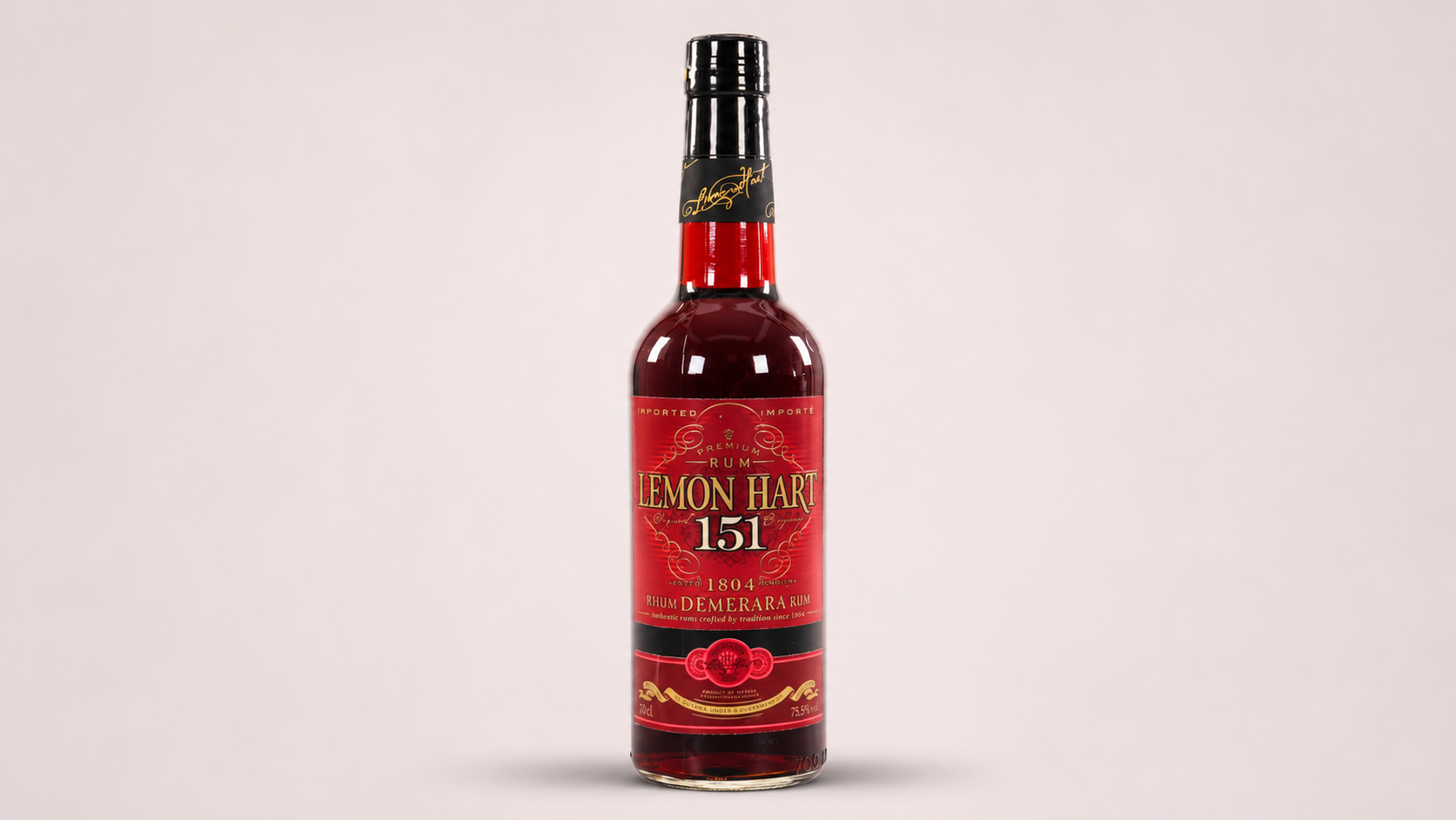
Lemon Hart 151 Demerara Rum, featuring the red-label presentation introduced in the early 2010s. A major design change accompanying the brand's relaunch in the United States.
The return of 151 was enthusiastically welcomed by tiki aficionados. At the Mai-Kai in Fort Lauderdale, a historic establishment opened in 1956, Lemon Hart even regained its place in the cocktails from the spring of 2012. For enthusiasts seeking to recreate classic recipes, its availability represented far more than a simple new product launch: it marked the return of a style of rum that had become difficult to replace.
But this revival would suffer another interruption. In May 2014, Ed Hamilton announced that Mosaiq had decided to suspend new bottlings of Lemon Hart 151 intended for this American distribution network, at least until the middle of the following year. The remaining stocks gradually ran out, and bars once again had to search for alternatives. At the Mai-Kai, the 151 was temporarily replaced by other rums, including Gosling's Black Seal 151, whose flavour profile was nevertheless quite different from that of a Demerara.
And this time, Ed Hamilton was not about to sit back and do nothing. In January 2015, he introduced his own Guyanese rums, Hamilton 151 Overproof and Hamilton 86, produced using rums from Demerara Distillers. A new reference thus entered the tiki world, brought to market by the very importer who had helped bring Lemon Hart back just a few years earlier. The popularity of a historic brand had therefore helped sustain demand for a particular style of rum, eventually encouraging the arrival of new competitors.
Lemon Hart, however, had not said its last word. In 2016, Mosaiq organised another American relaunch. This time, the brand returned to a visual identity inspired by its vintage bottles, with a yellow and red label recalling its historic presentations. The range was built primarily around the 151 proof and the Original 1804 at 40% ABV, joined by a spiced expression called Blackpool. Demerara Distillers became the partner responsible for American imports, while the rums were presented as distilled, aged and blended in Guyana.
The return of 151 allowed the brand to reconnect with its traditional audience. But it was also accompanied by a marketing strategy firmly focused on its heritage. Mosaiq once again emphasised the full name Lemon Hart & Son, the year 1804 and the old references to the Royal Navy. The strategy was clear: to remind consumers that behind this famous tiki-bar rum stood a firm whose history stretched back through several generations of merchants.
And the brand did not stop there. It also introduced a series called Redux, comprising three expressions bottled at 86, 96 and 114 US proof, equivalent to approximately 43%, 48% and 57% ABV respectively. Created under the direction of master blender Michael Booth, these expressions were presented as interpretations of historic rum styles. The 86 Redux notably evoked the rums sold before American Prohibition, while the 96 Redux paid tribute to the earliest tiki cocktails.
As for the 114 Redux, it holds particular significance for anyone interested in Lemon Hart's history. At 57% ABV, it returns to approximately the old British proof strength, recalling an earlier Demerara expression bottled at 114 proof that we had already encountered in American records from 1945. The name and strength therefore revive a genuine historical precedent, even if nothing allows us to claim that the modern blends faithfully reproduce the recipes of the 1940s.
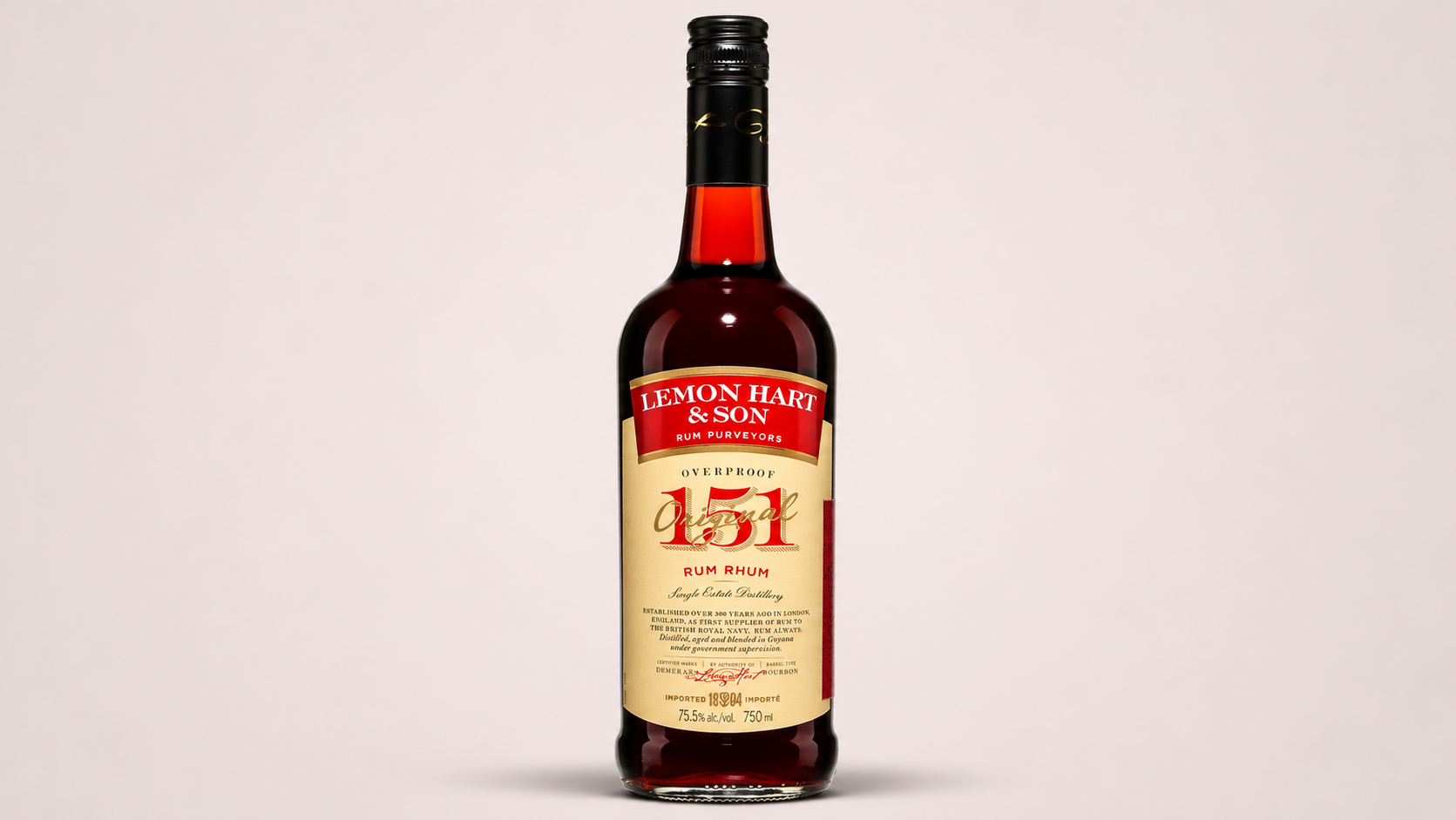
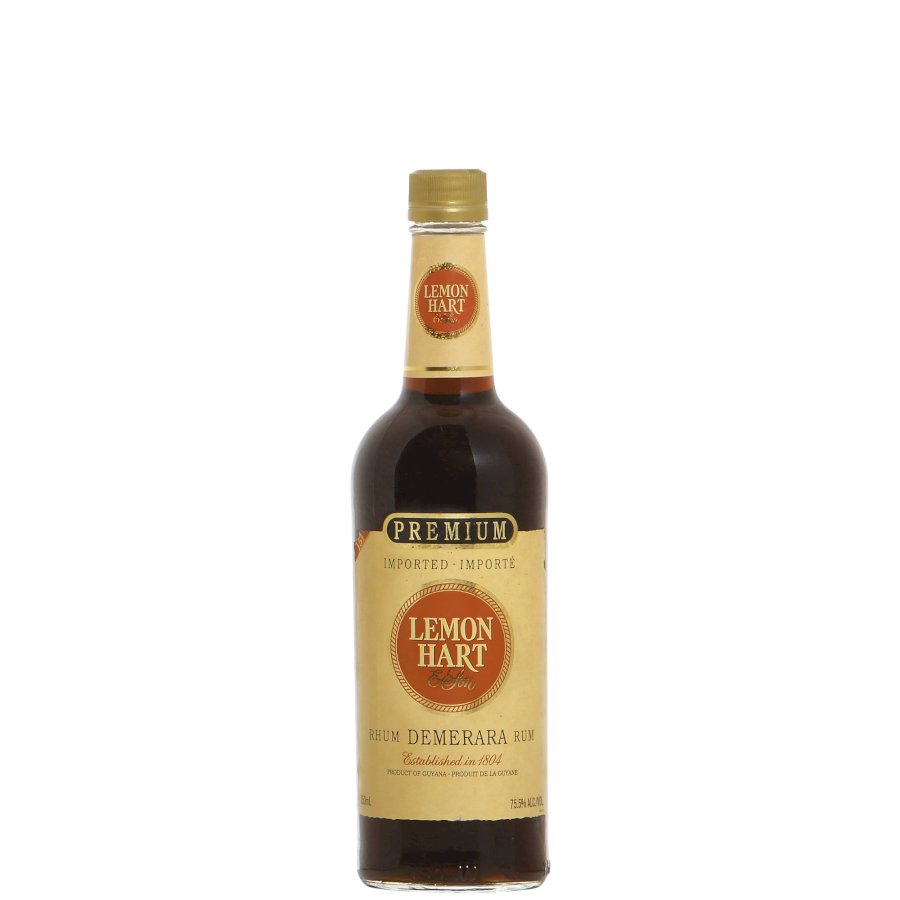
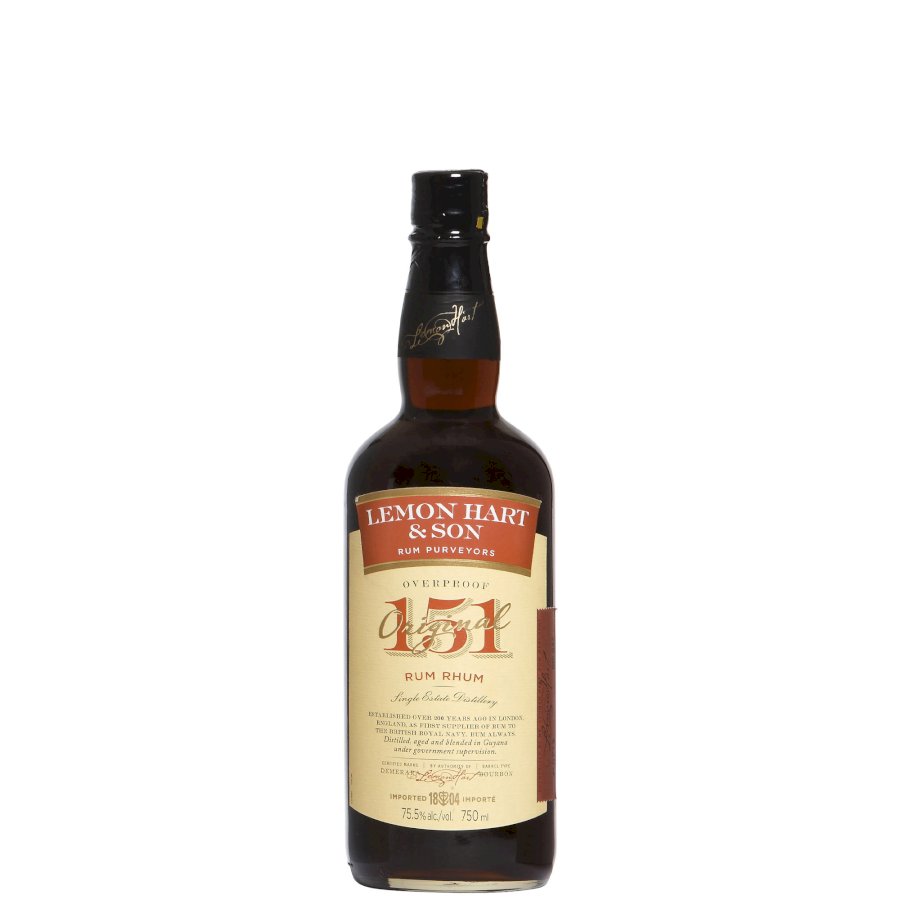
Contemporary Lemon Hart & Son 151 proof, 75.5% ABV, in its yellow and red presentation inspired by the firm's vintage labels. A renewed visual identity that reconnects the brand with its history.
But behind the new labels and references to the past, what do we really know about the contents of today's bottles? The brand describes its products as blends of Demerara rums distilled, aged in ex-bourbon casks and blended in Guyana. It also highlights the technical heritage of Diamond, with its historic wooden stills and its various distillation marks.
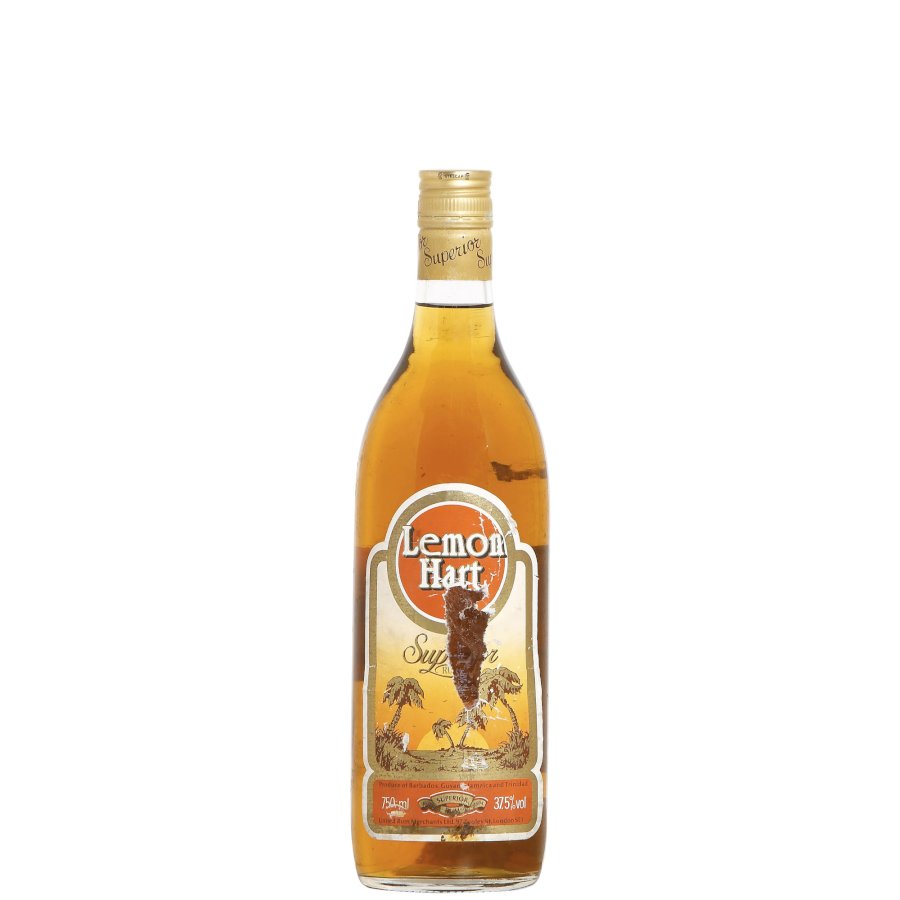
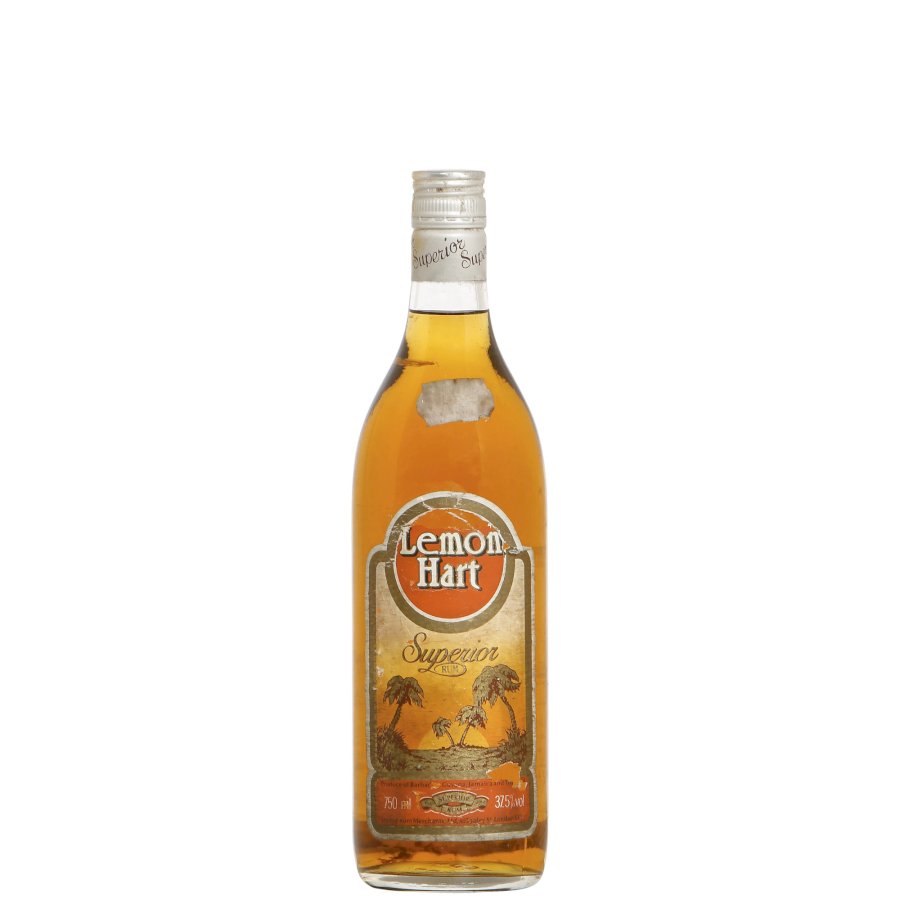
Nevertheless, several essential pieces of information are still missing if we are to make a rigorous comparison with historic Lemon Hart bottlings. Which precise distillation marks go into each blend? In what proportions? How old are the different components? And how have these parameters evolved since the old London bottlings? Of course, current commercial descriptions cannot answer all these questions, and that is also what makes vintage Lemon Hart bottles so fascinating for collectors. A 151 from the 1940s, a Demerara from the 1960s, a Golden Jamaica from the 1970s or a Superior from the 1980s represent far more than changes in label design. They belong to different commercial periods, sometimes distinct supply networks and blending traditions that may have evolved considerably. And two bottles bearing the same name do not necessarily tell the same story...
The contrast with the firm's beginnings is striking. In the 19th century, Lemon Hart marketed Jamaican rums, expressions sometimes aged for several decades, and various overproof rums intended for international markets. Today, its identity rests primarily on its Demerara heritage, the British tradition of powerful rums and its place in the history of tiki cocktails. The brand has preserved part of its roots, while gradually allowing other chapters of its former range to fade into obscurity.
So, is today's Lemon Hart still the same rum it once was? The answer calls for some nuance. The name endures, Demerara rums remain central to its identity, and some of the region's historic distilling traditions have been preserved. But the companies have changed, distilleries have been consolidated, ageing and blending locations have evolved, and the exact recipes of the old expressions still remain beyond our reach...