

Bally : when rum meets the Stars

We were already familiar with J. Bally's great vintages, its famous pyramid-shaped bottles and the treasures long preserved in the ageing warehouses of Lajus. But behind certain labels lie far lesser-known stories, where Martinican rum crosses paths with French music, the world of entertainment, fine dining and even underwater exploration. And sometimes, with a few rather unexpected guests...
Over the years, special bottles have borne the names of famous personalities, while others seem to have been intended for friends, close acquaintances or members of the Bally family. Tokens of friendship, personal tributes, exclusive limited releases or simply commercial ventures? Behind these bottles, some of which have now become almost impossible to find, another chapter in the history of the house begins to emerge: a more personal story, and a rather surprising one at that.
Eddie Barclay: From 45 RPM to 45% ABV
When we think of Eddie Barclay, records, famous artists, white suits and legendary parties in Saint-Tropez immediately come to mind. But the celebrated music producer clearly had a few other strings to his bow. And among the curiosities he left behind are several bottles of Martinican rum bearing his name... After all, for the king of the 45 RPM single, 45% ABV was perhaps another way of making heads spin.
Born Édouard Ruault in 1921, Eddie Barclay began his career in jazz before becoming one of the most influential figures in the French music industry. Together with his wife Nicole, he helped popularise the long-playing record in France and built a record label that welcomed some of the greatest names in French music: Charles Aznavour, Dalida, Léo Ferré, Jacques Brel, Eddy Mitchell and many others (apologies to our English-speaking readers). From the 1970s onwards, his name also became inseparable from the jet set and the legendary parties of Saint-Tropez, where singers, actors and celebrities from around the world rubbed shoulders.
But what does any of this have to do with Martinique and Bally rum? The answer can be found on a remarkable bottle preserved in our collection. It is a Très Vieux Rhum de la Martinique, vintage 1970, from the Plantations Lajus in Le Carbet, bottled in a 70 cl format at 45% ABV. Its label, decorated with a historic scene, bears a rather unusual inscription: "Distribué par Eddie Barclay" (Distributed by Eddie Barclay). At the bottom of the bottle is another detail: the address of Barclay Organisation SNC, 6 rue Picot, 75116 Paris. And unlike the house's usual presentations, the name J. Bally does not appear on the main label. Instead, the emphasis is placed on Plantations Lajus, the historic birthplace of the brand.
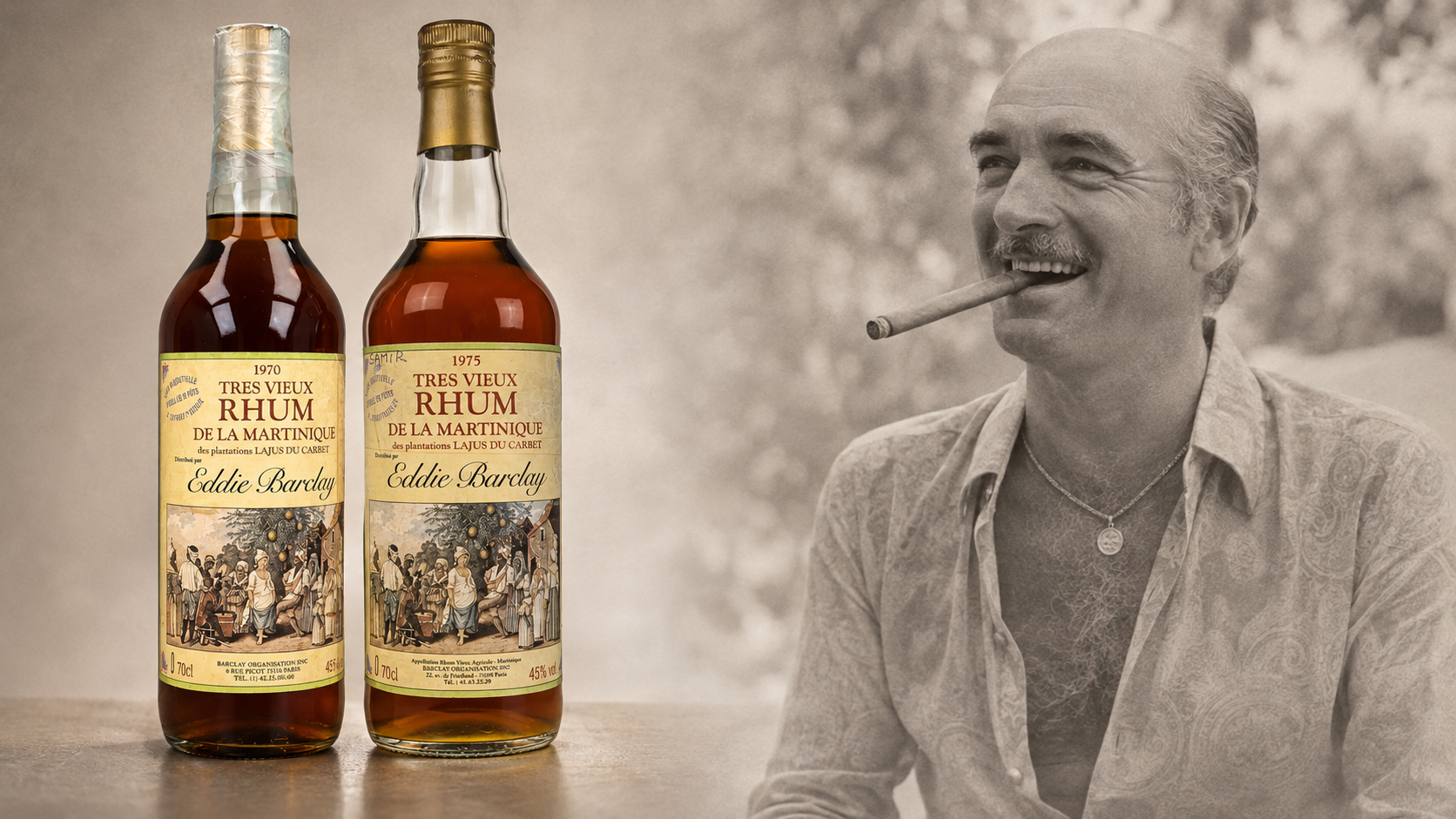
Eddie Barclay and his two vintage Martinican aged rums, from 1970 and 1975. Produced at Plantations Lajus in Le Carbet, these bottles bear the name of the famous music producer, illustrating an unexpected encounter between the world of entertainment and that of Martinican rum.
The discovery is all the more interesting because this is not an isolated example... Another bottle, this time vintage 1975, appeared in 2023 on the Excellence Rhum website. It features a very similar label, again bearing Eddie Barclay's name, but with a different Parisian address, on Avenue de Friedland. The retailer estimates that it was bottled between 1982 and 1985, although this dating has yet to be confirmed. This example also bears a handwritten inscription, "Samir", which the seller attributes to the butler of fashion designer Daniel Hechter, a close acquaintance of the producer. An entertaining lead, although no independent documentation has yet allowed us to verify the anecdote.
But why was Eddie Barclay having his own bottles of Martinican rum produced? For his parties, his friends or his business associates? Until now, we had little more than theories. Then we managed to track down Dominique de La Guigneraye, who was responsible for developing Bally rums at the time. And suddenly, our story took a much more interesting turn, as he personally recounted the circumstances behind this remarkable collaboration.
It all began with a telephone call. One day, Dominique was contacted by a close associate of Eddie Barclay, who explained that the famous producer wanted to create his own special rum bottling. As luck would have it, Dominique was due to travel to Paris a few days later. A lunch was therefore arranged at Barclay's home, in the company of several well-known personalities. And naturally, our man did not arrive empty-handed: he brought two samples of aged Bally rum, one from 1970 and the other from 1975. Two prestigious vintages that the house was still keeping in large wooden vats at the time.
Around the table, it was time for a tasting. Eddie Barclay sampled both rums, compared them and eventually made his choice. As Dominique told us: "He preferred the seventy." The producer then ordered a few hundred bottles, specially labelled with his name. So there we have the origin of our famous Lajus 1970! As for the 1975 vintage, of which surviving examples are also known, it represents another bottling associated with Barclay, although the exact circumstances of its commercial release remain to be clarified.
But the best was yet to come. For Eddie Barclay, evidently delighted with his new acquisition, decided to share it with another singer from his circle: Philippe Lavil. He invited him to lunch and, bursting with pride, presented his bottle, encouraging him to taste his rum. And then came the surprise! Philippe immediately recognised what was in his glass: Bally rum! A delightful scene that Dominique recounted to us with considerable amusement.
And with good reason! Although Philippe Lavil had been recording his first records with Barclay as early as 1969, he was also, and above all, the grandson of Jacques Bally and the nephew of Jean Bally. So there was Eddie Barclay, proudly presenting his new creation to a singer who had known the house since childhood! Suffice it to say that our producer could hardly have chosen a better person to taste it. And to add yet another name to this little family gathering, let us remember that Barclay had also signed a certain Pierre Perret back in the 1950s, with his first records appearing on the label in 1957. It really is a small world, especially when Bally is being served...
One final anecdote, and not the least surprising: some of these bottles later followed a rather unexpected path. During our conversation with Dominique de La Guigneraye, we told him that we had found several examples originating from Eddie Barclay's former chauffeur. The driver had kept a small stock of them, but as he did not drink alcohol, he eventually began selling them off little by little. That is how some of these unusual bottles found their way into private collections, including our own. A rather remarkable provenance, adding yet another entertaining twist to their story!
We still do not know exactly how many bottles were produced, when the different versions were bottled or how widely they were distributed. But one thing is now certain: the Eddie Barclay special bottling originated from a personal request by the producer and a tasting organised with Dominique de La Guigneraye. A genuine episode in the history of the Bally house, bringing together the entertainment world, aged Martinican rums and a few unexpected family connections. And since Philippe Lavil has now made his appearance in our story, let us take a closer look at this singer who quite literally had rum running through his veins...
Philippe Lavil: Music in His Blood... and Rum in His Heritage
After Eddie Barclay, let us spend a little more time in the world of French music. But this time, our protagonist is not merely an acquaintance or associate of the famous Martinican rum producer: he is actually part of the family! For behind the stage name Philippe Lavil stands a certain Philippe Durand de La Villejégu du Fresnay, born on 26 September 1947 in Fort-de-France. His mother, Marthe Bally, was one of the daughters of Jacques Bally, founder of the famous rum house. In other words, Philippe Lavil is the grandson of Jacques Bally and the nephew of Jean Bally. Which goes a long way towards explaining why the singer has always maintained such a special connection with Martinique and his family history.
Young Philippe grew up on the island, where his parents, Marthe Bally and Max Durand de La Villejégu du Fresnay, ran a banana plantation in Le François. He was also familiar with his grandfather's facilities in Le Carbet, particularly the great ageing warehouses where Bally rums matured. In 1960, at the age of thirteen, he left Martinique to continue his education in mainland France. It was at a boarding school in the Drôme region that he truly discovered the guitar, encouraged by his English teacher, a certain Graeme Allwright, who would himself become a well-known figure in French music. His parents would have preferred him to pursue a career in business, but the young man apparently had other plans...
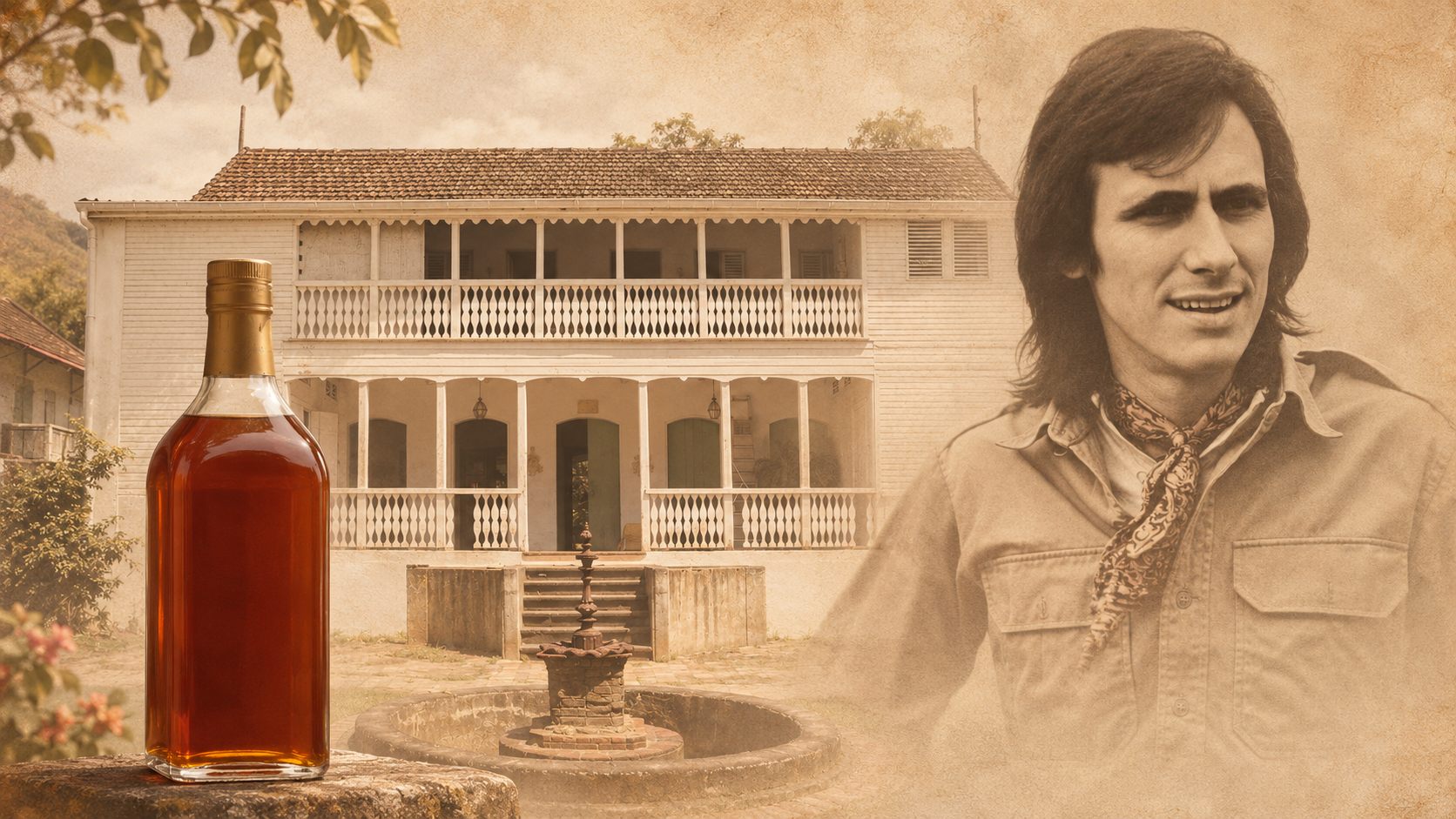
Philippe Lavil, grandson of Jacques Bally and nephew of Jean Bally. A family history closely intertwined with that of Martinican rum. Visual: ROW Spirits.
The next chapter brings us straight back to our previous protagonist. In 1969, Philippe Lavil recorded his first singles with Barclay, including À la califourchon. The following year, Avec les filles je ne sais pas brought him his first hit. His career would then go through some difficult periods before making a spectacular comeback in 1982 with Il tape sur des bambous. Other successes followed, including Elle préfère l'amour en mer and Kolé séré, recorded as a duet with Jocelyne Béroard of the band Kassav' in 1987. A career deeply influenced by Caribbean rhythms, like a constant echo of his native island.
But the most interesting part of our story lies elsewhere. Philippe Lavil never forgot his grandfather's rum: in 2011, he released an album entitled La Part des anges (The Angels' Share), whose title track draws its inspiration directly from the world of spirits. Interviewed by Le Parisien on 1 August 2011, the singer explained that the title refers to the evaporation of alcohol during barrel ageing, recalling the rum produced by Jacques Bally. A poetic way of turning a family memory into a song, several decades after leaving Martinique.
And that memory is still very much alive: appearing on the France 2 television programme Télématin in 2026, Philippe Lavil looked back on his childhood and recalled how his maternal grandfather would sometimes take the children into the ageing warehouses. He remembers the enormous wooden vats in which the rum matured, and especially the powerful alcohol fumes that prevented them from staying inside for too long. An anecdote told by someone who had known Jacques Bally and his facilities from the inside. More than half a century later, the aromas of his grandfather's aged rums still seem to accompany him.
But let us return to our mysterious bottles, because Philippe Lavil seems to have inherited rather more than memories! An old auction description claimed that Jean Bally had set aside three barrels from the 1991 vintage: the first for his nephew, the second for his friend Jacques-Yves Cousteau and the third for Pierre Perret. But who exactly was this famous nephew? And, more importantly, what had become of his rum? Until now, the archives offered few clues. Fortunately, our recent conversation with Dominique de La Guigneraye, who was involved in developing the Bally house at the time, has provided us with a few answers...
Dominique explained that, during this period, he had devised a programme allowing rum enthusiasts and certain well-known personalities to acquire their own barrel of Bally rum. An original initiative, presented notably through a parchment certificate sent to its recipients, which anticipated what we now know as private casks. But not all these barrels were necessarily sold: some were also given away, particularly to help promote the house. And when we asked him about the lucky recipients, Dominique spontaneously mentioned "Philippe Lavil, of course", before going on to mention Pierre Perret and other personalities. So there we have first-hand confirmation: Philippe Lavil had indeed received a complimentary barrel as part of this programme!
A few details, however, remain to be clarified. Although Dominique's testimony confirms that a barrel was allocated to the singer, he did not specify its vintage, its bottling date or the circumstances under which this private reserve was eventually collected. Was it precisely the famous 1991 barrel mentioned in the auction description? That is entirely possible, but we cannot yet say for certain. One thing is clear: behind this mysterious reserve lay a genuine initiative by the Bally house, rather than a mere collectors' legend.
From childhood memories of the Lajus ageing warehouses to Eddie Barclay's recording studios, Philippe Lavil ultimately represents a remarkable link between two worlds. His grandfather's rum followed him into his songs, while a special reserve was set aside for him several decades later. A wonderful way of keeping the family story alive, even after choosing a career far removed from the plantations of Le Carbet. But Philippe Lavil was not the only singer to benefit from such generosity. Another artist was also to receive his own barrel of Bally, with a rather unusual idea: giving a dog the starring role on his label!
Pierre Perret, Jean Bally and the Famous Groucho
After Philippe Lavil, let us stay in the world of French music, this time with someone who hardly needs an introduction. Pierre Perret, his famous holiday camps, his cheeky song about a certain part of the male anatomy, and his tenderness for caged birds... But did you know that the singer was also a great lover of fine bottles? A passionate gourmet with a particular fondness for wine and spirits, he maintained a personal cellar for many years that would have made plenty of collectors green with envy. And among his treasures was a rather unusual Martinican rum, born through his friendship with Jean Bally. A bottle whose real star, however, was not the singer himself, but a certain... Groucho.
To understand this remarkable story, we need to go back to the 1991 vintage. According to information published when part of Pierre Perret's personal cellar was auctioned, Jean Bally supposedly gave the singer a quantity of rum distilled that year. Pierre Perret then reportedly arranged for it to be bottled, giving it a very personal presentation. Rather than using the house's famous labels, he turned to his son Alain Perret, who designed a label entirely dedicated to the family dog: Groucho.
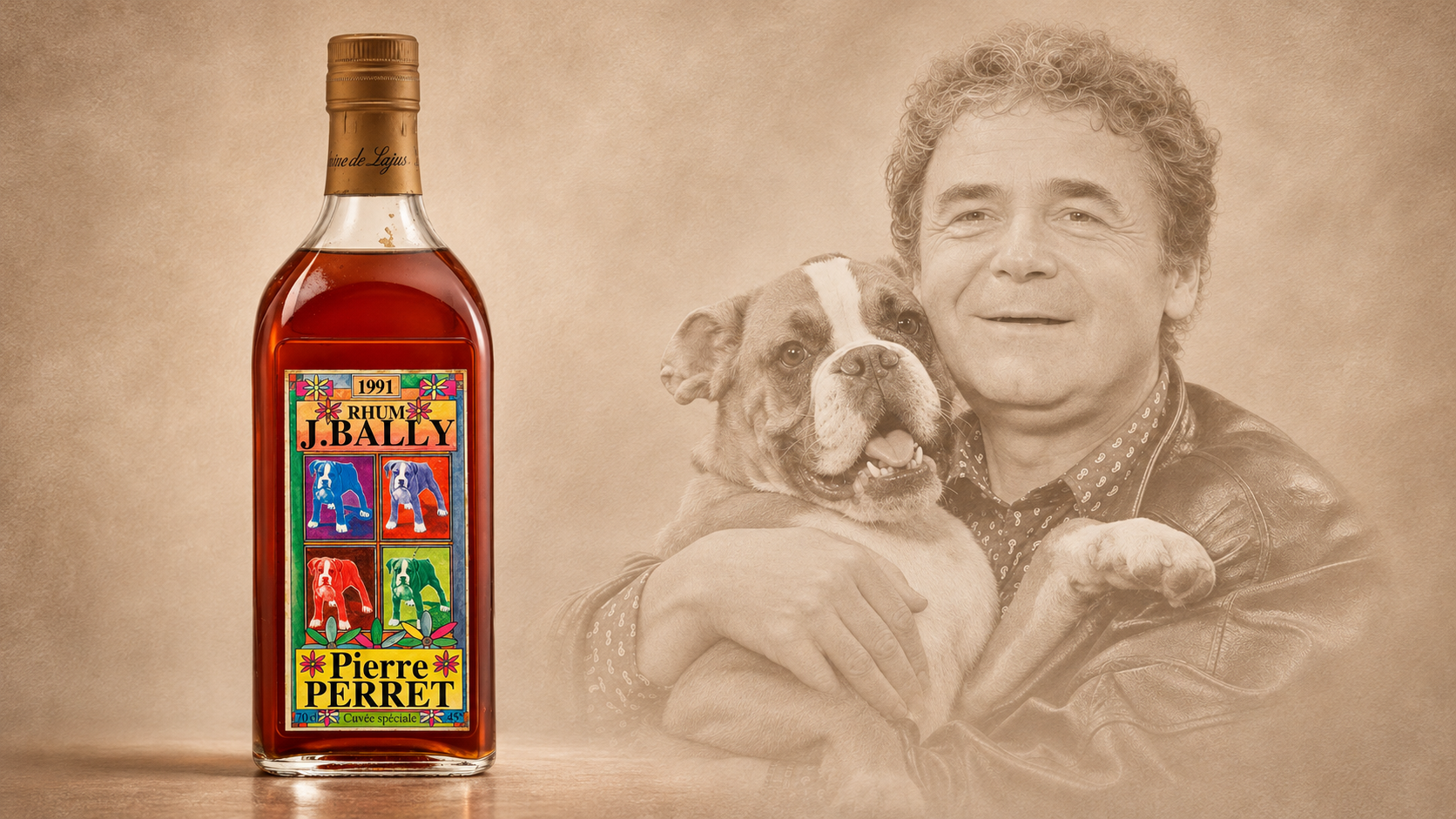
Pierre Perret and his faithful companion Groucho, immortalised on the label of this special J. Bally 1991 bottling.
The result is as unusual as it is endearing. On a label resembling a miniature painting, Groucho appears four times, framed in blue, orange, red and green, while the names J. Bally and Pierre Perret occupy the top and bottom of the composition respectively. A cheerful, almost childlike presentation, far removed from the usual seriousness of prestigious vintage rums. But who exactly was this dog, important enough to become the emblem of such an exceptional bottling?
Groucho was a boxer, the faithful companion of Pierre Perret and his wife Rebecca. And behind his name lies another personality well known to French audiences: Bernard Pivot. In a newspaper article published in January 1993, Pierre Perret recalled that the famous journalist was having dinner at his home when he met the young puppy, which had recently become attached to the singer. Looking at him, Pivot supposedly exclaimed: "He looks like a Groucho!" An obvious reference to Groucho Marx, the most famous of the Marx Brothers. The name stuck, and the dog seemed to understand immediately that he would now have to live up to his illustrious namesake...
Because Groucho was apparently quite a character. Always ready to clown around, he had developed a particular habit of stealing his owner's slippers and glasses. And whenever Pierre Perret wanted to play tennis, the dog clearly believed that all the balls belonged to him! His exuberant personality even earned him an appearance on television. In 1991, Groucho accompanied Pierre Perret onto the set of Mille et une pattes, an animal-themed programme broadcast on the French television channel La Cinq and presented by veterinarian Pierre Rousselet-Blanc. This delightful piece of television history has been preserved and can now be watched on the singer's official website. And for fans of this vintage and of dogs, here is our star in action:
But let us return to our bottle, because its story has just delivered another surprise... Until now, we mainly knew an anecdote reported in an old auction description: Jean Bally had supposedly personally selected three barrels from the 1991 vintage, intended respectively for his nephew, Commander Cousteau and Pierre Perret. A lovely story, but one for which we had never managed to locate the original documents. Then our recent conversation with Dominique de La Guigneraye, who was involved in developing Bally rums at the time, shed a much clearer light on the matter...
As Dominique explained earlier, he had devised a programme allowing rum enthusiasts and certain well-known personalities to acquire their own barrel of Bally rum. And our singer was among the lucky recipients. Dominique confirmed it to us without hesitation: "I had given one to Pierre Perret", before explaining that the gift was connected to Perret's friendship with Jean Bally. This finally sheds light on the circumstances behind this special bottling. Jean Bally provided the personal connection with the singer, while Dominique de La Guigneraye states that he himself offered the barrel as part of his private reserve programme.
A few mysteries nevertheless remain. An auction description published by Whisky.Auction in April 2019 claims that Pierre Perret's barrel yielded 340 bottles, bottled without filtration. Not an easy figure to verify. And although the rum clearly bears the 1991 vintage, its exact bottling date remains unknown.
The story resurfaced in June 2018, when the auction house Mercier & Cie organised the sale of part of Pierre Perret's personal wine cellar in Lille. Among the great Bordeaux wines and other prestigious bottles were around thirty of these famous Bally 1991 bottles. The auction presentation recounted the story of the gift and the label designed by Alain Perret. A wonderful way to discover that these bottles, long kept in the singer's cellar, were now about to find their way into the collections of other enthusiasts.
Since then, the Pierre Perret bottling has made several appearances at specialist auctions. In June 2021, an example offered by the Alexandre Landre auction house even fetched €1,688. Quite a remarkable destiny for a bottle that was clearly never intended to be an ordinary commercial release. And although a few questions remain unanswered, we now know that it formed part of a genuine initiative by the Bally house: a personal reserve offered to a friend of Jean Bally, before receiving a label designed by the singer's son. A story of friendship, family and shared heritage, with a particularly mischievous dog taking care of the publicity!
In the end, this Bally 1991 is unlike any other. A Martinican vintage, a specially designed label, a famous singer, a boxer named by Bernard Pivot... It could only have been Pierre Perret who brought us a story like this. But remember that old auction description mentioning three mysterious barrels. Another name appeared in it, that of a close friend of Jean Bally whom Dominique also told us about. And this particular gentleman was no singer: he was rather more accustomed to travelling... beneath the surface of the oceans.
Jean Bally and Cousteau: A Friendship Twenty Thousand Leagues Under the Sea
After Pierre Perret's songs and Groucho's mischievous antics, let us change the scenery completely. This time, no recording studios or television sets, but a red woollen cap and a famous white ship. For among Jean Bally's friends was a man whose adventures inspired generations of dreamers: Commander Jacques-Yves Cousteau. And contrary to what one might imagine, their friendship was not limited to sharing a few glasses of aged rum: it was also fuelled by a common passion for the depths of the Caribbean Sea.
Jean Bally was much more than the worthy heir of Jacques Bally. A former mayor of Le Carbet, departmental councillor and passionate advocate for the development of aquaculture in Martinique, he also had a genuine love of the sea. A passion he shared with Cousteau, who had become a close friend. When Jean Bally passed away in August 2009, the Martinican news website Bondamanjak recalled that the two men would regularly swim together along the coast between Le Carbet and Saint-Pierre whenever the Commander visited Martinique. But their shared interest in the underwater world went far beyond a few swims between friends...
And we have now been able to confirm this friendship through a particularly well-placed witness: Dominique de La Guigneraye. During our recent interview, he reminded us that Jean Bally was not only a friend of Commander Cousteau, but also of Albert Falco, his legendary fellow explorer aboard the Calypso. And Dominique was not describing a casual social acquaintance: "He was a very close friend," he told us, referring to the relationship between Jean Bally and Cousteau.
To understand what brought them together, we must go back to one of the greatest disasters in Martinique's history. On 8 May 1902, the eruption of Mount Pelée devastated the town of Saint-Pierre, turning its harbour into a maritime graveyard. Sailing ships, cargo vessels and steamers were engulfed, taking their crews, passengers and cargoes with them. For decades, these ships remained at the bottom of the bay, sometimes known to local fishermen but still largely unfamiliar to the general public. Until new expeditions gradually began to reveal this extraordinary underwater heritage.
In 1974, diver Michel Météry, who had settled in Martinique a few years earlier, began exploring these wrecks. His discoveries soon attracted the attention of Albert Falco, the legendary diver and captain of the Calypso. Jean Bally also became involved in this adventure. A document published in 2019 by the association Contact-Entreprises, devoted to the heritage of Saint-Pierre, states that in 1977, Michel Météry and Jean Bally helped catalogue and introduce around a dozen wrecks in the bay to the public. So our rum producer had become an active participant in the rediscovery of a veritable sunken museum. It is worth remembering, however, that several of these sites were already known to Saint-Pierre's fishermen: their exploration and identification were very much a collective undertaking.
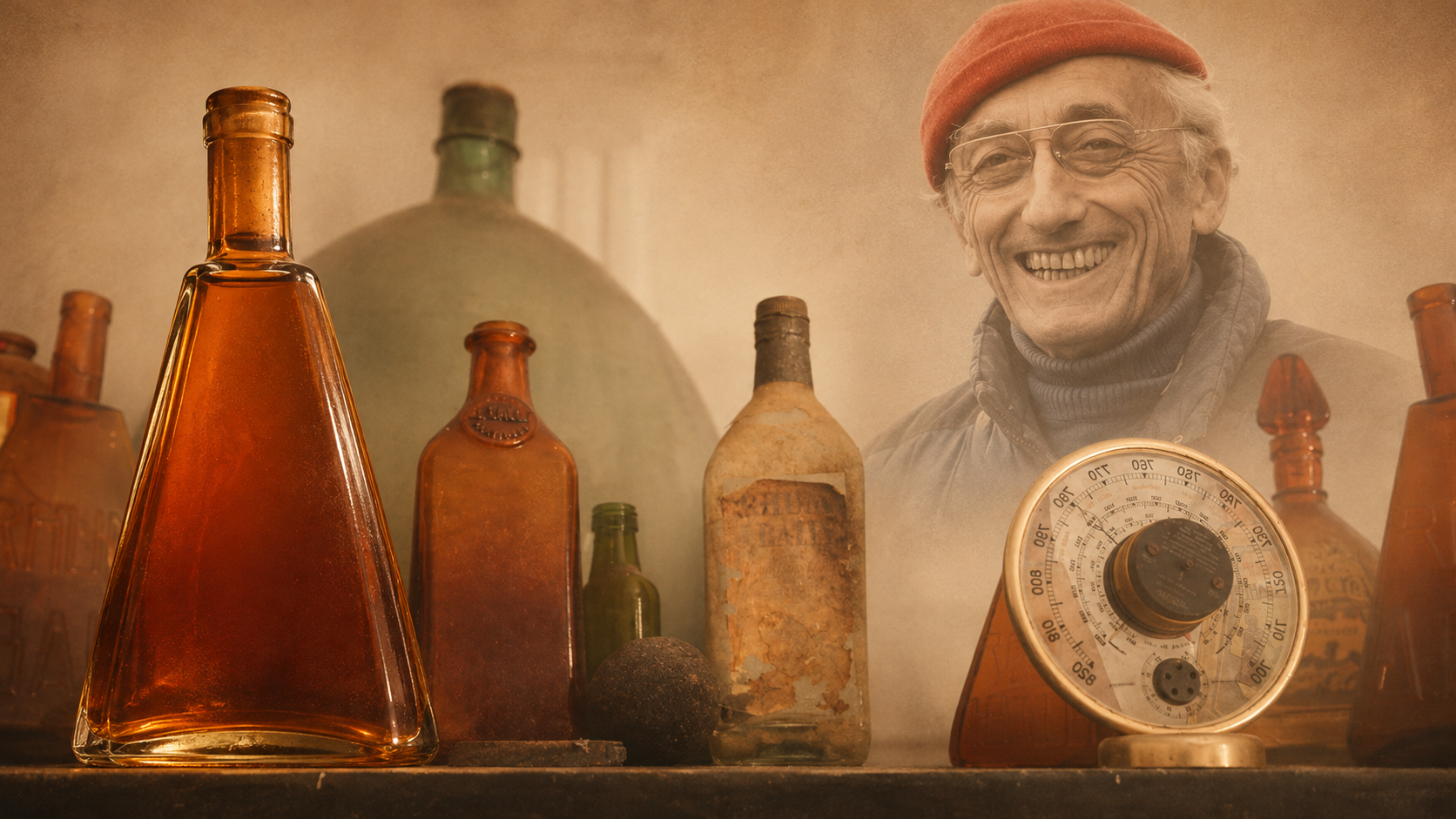
In 1979, the famous Calypso arrived in Saint-Pierre. Cousteau and his crew came to explore the wrecks left by the disaster, including the Roraïma, the Diamant, the Gabrielle and the Thérésa Lo Vico. These dives would provide part of the material for the documentary Fortunes de mer, broadcast in 1980, in which the Commander took viewers on a journey through sunken ships and their sometimes tragic histories.
One of these wrecks seems to have made a particularly strong impression on Cousteau: the Roraïma, a large steam cargo ship destroyed by the 1902 eruption and resting at a depth of around fifty metres. Its metal structures, gradually colonised by marine organisms, give it an almost ghostly appearance. The Commander is even said to have given it a particularly poetic nickname: "the wreck with white hair", a reference to the long, pale, branching growths covering parts of its hull. A beautiful image for this giant of the seas, which had become, through tragedy, one of the most extraordinary witnesses to the disaster.
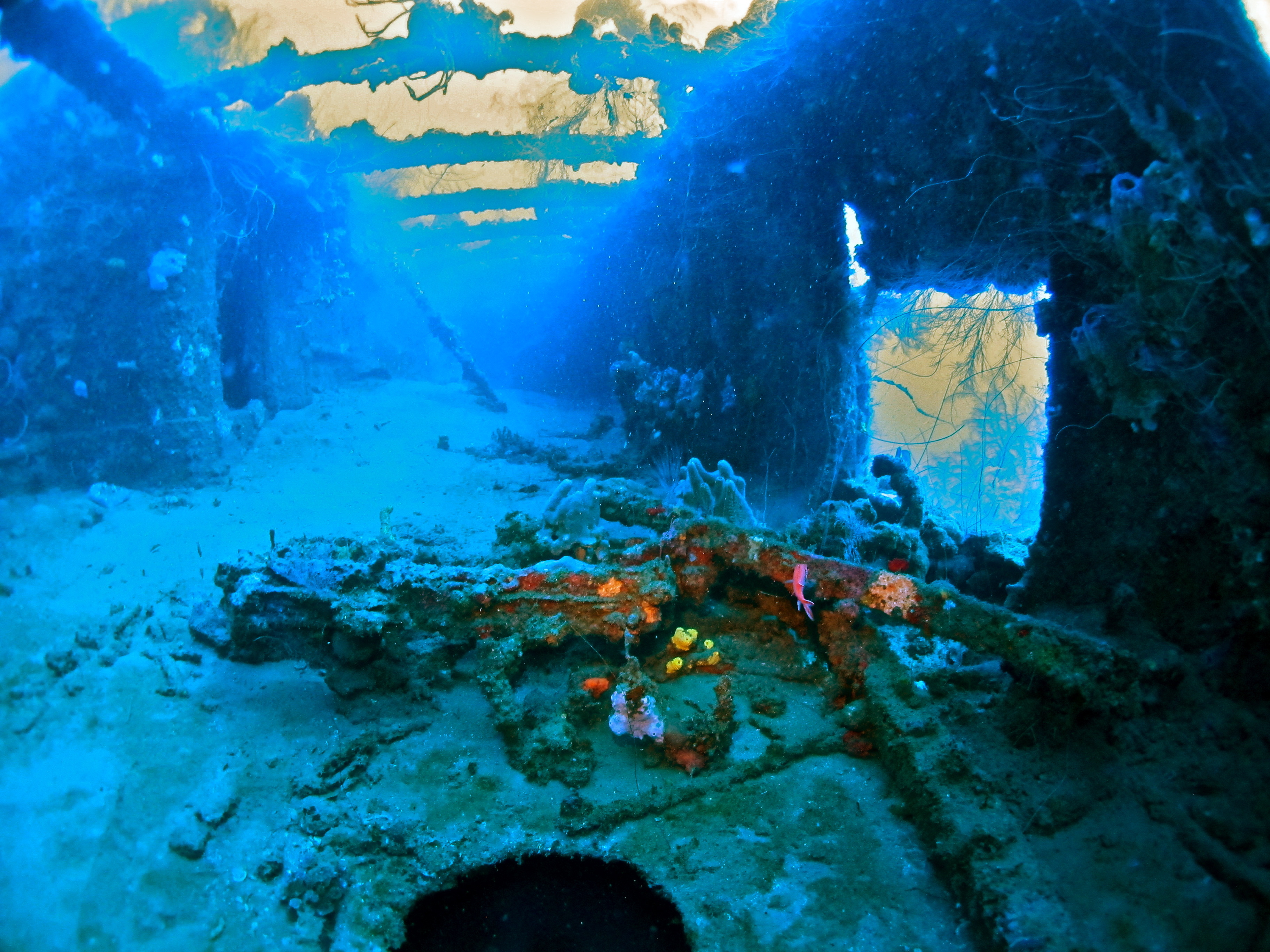
Inside the wreck of the Roraïma, in the bay of Saint-Pierre. Photograph: Marc Verstraete. Source: Wikimedia Commons, CC BY-SA 4.0 licence.
But Jean Bally was not content simply to support the growing interest in these shipwrecks. He had also envisioned a particularly ambitious project: the creation of a museum dedicated to the sunken ships of Saint-Pierre. Illustrator and diver Dominique Serafini, who would later join Cousteau's team, took part in its preparation. Among other things, he created a large-scale model of the bay and its wrecks, while a slideshow was developed with photographer Philippe Bastin. The aim was to allow visitors to discover these remains and their history without necessarily having to descend beneath the waves themselves. Unfortunately, the project never came to fruition in its originally intended form... An unrealised dream, but one that illustrates Jean Bally's commitment to preserving and sharing Martinique's heritage.
His close relationship with Cousteau now takes on a whole new meaning. One had devoted his life to exploring the oceans, while the other continued his family's rum-making legacy alongside his many commitments to his island. Two very different paths, but the same curiosity about what lay beneath the surface. And when Jean Bally passed away in 2009, his friendship with the Commander was still among the memories recalled by the Martinican press.
But let us return to our mysterious bottles, because one question remains. An old auction description for the Pierre Perret 1991 bottling claimed that Jean Bally had reserved a barrel from the same vintage for his friend Cousteau. Entirely possible, but Dominique de La Guigneraye did not explicitly confirm that a barrel had been allocated to Commander Cousteau. So the mystery remains unsolved...
And to complicate matters further, to our knowledge, no bottle bearing Cousteau's name has ever been found or documented. Did the Commander really receive a personal reserve? Was he given a barrel that never resulted in a personalised bottling? For now, there is no way to be certain.
One thing is certain: the friendship between Jean Bally and Jacques-Yves Cousteau was far more than a collector's anecdote. It belongs to a very real history, that of the rediscovery of Saint-Pierre's shipwrecks, the great underwater explorations around Martinique and a museum that might have been built at the foot of Mount Pelée. As for that mysterious barrel of rum, perhaps it is still resting somewhere, hidden from view... But for our next encounter, let us leave the depths of the Caribbean Sea behind and head for Italy, where another great name was to receive an equally special Bally bottling. This time, no Commander in a red woollen cap, but a true legend of fine dining...
Peppino Cantarelli: A Bally at a Michelin-Starred Table
After the underwater explorations of Jean Bally and Commander Cousteau, let us return to dry land. Our destination is Italy, more precisely Samboseto, a small village tucked away in the countryside of Emilia-Romagna, a few kilometres from Busseto. Here, no famous recording artists or explorers in red woollen caps, but a man whose name inspired awe among the greatest food lovers: Giuseppe "Peppino" Cantarelli. And although he may have been less familiar to the general public, in the world of gastronomy, our man was a true legend. A legend whose name would also find its way onto a bottle of J. Bally...
The story begins in a modest country grocery shop selling tobacco, a few food products, cured meats and wine. Together with his wife Mirella Del Nevo, Peppino gradually transformed this little shop into an essential destination for food lovers. He developed a passion for fine wines and spirits, travelling through the French vineyards in search of exceptional bottles. She created a style of cooking deeply rooted in local traditions, but executed with remarkable precision. In 1953, their establishment truly began to flourish. Then came the accolades: a first Michelin star in 1967, followed by a second in 1970. Quite an achievement for a little trattoria lost in the middle of the Italian countryside!
Behind its unassuming façade, the Cantarelli restaurant had become a meeting place for an extraordinary clientele. Writers, industrialists, artists and some of the biggest names in cinema could all be found there. Robert De Niro, Gérard Depardieu, Donald Sutherland and Bernardo Bertolucci were among its visitors, several of them during the filming of 1900, released in 1976. People came as much for Mirella's dishes, including her famous savarin di riso, as for the incredible wine cellar assembled by Peppino. A collection of prestigious wines, champagnes and whiskies that would have made many enthusiasts green with envy. The contrast was remarkable: a simple village shop, and behind its door, one of the finest restaurants in Italy...
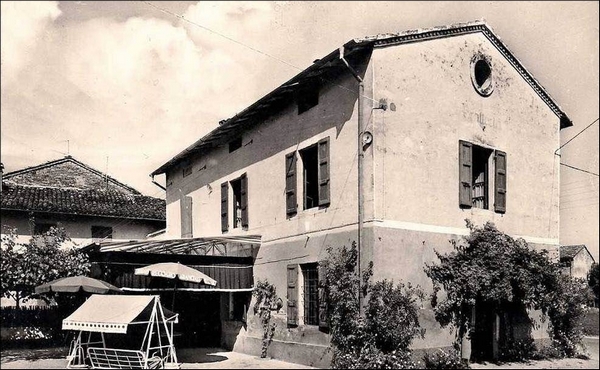
The Cantarelli trattoria in Samboseto, a restaurant that became legendary in the history of Italian gastronomy.
But how did such a remarkable character come to be associated with an aged Martinican rum? To understand this, we need to go back to 1975, when an eighteen-year-old Italian was working for Saint James. His name was Luca Gargano. One day, his agent called him with news that left him speechless: the famous Peppino Cantarelli wanted to order 600 bottles of Saint James rum! For Luca, who deeply admired the restaurateur, this was an unexpected opportunity to meet one of his idols.
The scene remained engraved in his memory. During an interview we conducted with him in April 2017, to mark Velier's 70th anniversary, Luca could still recall the emotion he felt upon discovering the restaurant: the smoky atmosphere, the tables that never seemed to empty, the food, the wines and the passionate clientele... Then Peppino appeared. He explained to the young man that he had known his father, whom he greatly respected, before confirming his order. And then came the surprise: the restaurateur took out his chequebook, signed a blank cheque and left Luca to decide the price of the 600 bottles himself... Deeply impressed by this display of trust, Luca would later admit that it was only much later that he discovered he had actually lost his company money on the deal...
The years went by. The trattoria closed its doors for good on 31 December 1982, after nearly thirty years of success. Mirella passed away in 1986, but Peppino remained an absolute inspiration to Luca, as much for his appreciation of the finer things in life as for his simplicity and generosity. Meanwhile, the young Saint James representative had become one of the leading figures at Velier, the Genoa-based company specialising in the importation of wines and spirits. And when he decided to create a special rum selection, Cantarelli was naturally the first person who came to mind.
A few years after the closure of the restaurant, Luca therefore returned to see Peppino and proposed creating a special bottling in his honour. At the time, the J. Bally house still held a remarkable range of aged vintages. As Dominique de La Guigneraye, who was then involved in developing the house, recently explained to us, two particularly important reserves were still being kept in large wooden vats: the 1970 and 1975 vintages, alongside other rums still ageing in barrels. Several samples were sent to Italy and tasted together in the former restaurant in Samboseto. After comparing the different rums, Luca and Peppino finally settled on a Bally 1970. A lovely coincidence, since that was precisely the year the Cantarellis received their second Michelin star! For Luca Gargano, this bottle marked an important milestone: it was his very first special selection produced under the Velier name.
But how did this idea actually come to life on the Martinican side? Once again, our interview with Dominique de La Guigneraye helped us piece together the story. One day, he received a fax from Luca Gargano proposing a special bottling for the Italian restaurateur. Dominique still remembers the request: "There's a great gentleman in Italy, Mr Cantarelli, and we'd like to create a special bottling for him." His reply was immediate: "Yes, no problem at all." Luca then sent him a design for the label, which Dominique arranged to have produced. No lengthy negotiations or endless meetings: just a few exchanges, a wonderful idea and a bottle that would go down in history. Looking back, Dominique summed up the collaboration in just a few words: "It was all very simple." Sometimes, great stories really do begin with a simple fax...
The bottling was named J. Bally Réserve Cantarelli 1970. Presented in a 75 cl bottle at 45% ABV, accompanied by a matching presentation box, it was bottled on 12 December 1991, twenty-one years after its distillation. But unlike traditional presentations of aged Bally rums, its packaging immediately stood out thanks to an unusual arrangement of yellow, green, orange and red checks. A label that looked almost as though it had come straight from a dressmaker's workshop. And with good reason: it, too, had a family story behind it...
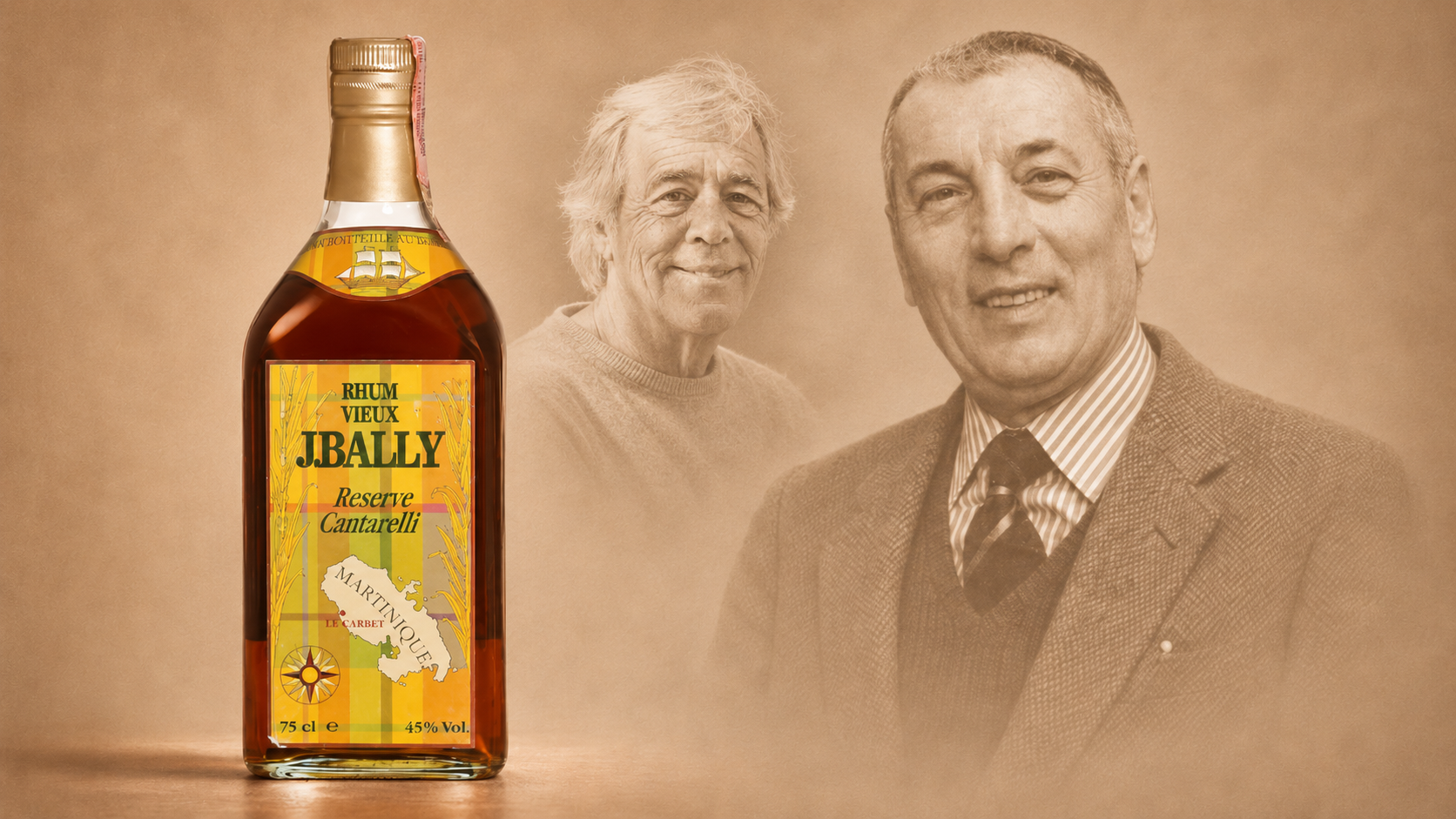
Luca Gargano and the Réserve Cantarelli 1970, a special bottling created in tribute to the famous Italian restaurateur Peppino Cantarelli. Visual: ROW Spirits.
For behind those colours lies a charming little anecdote that Luca shared with us in 2017. While searching for an original design for this special reserve, he came up with the idea of using a scanner to reproduce a very particular piece of fabric: a madras jacket he had bought in Martinique for his daughter Maria Margaux, who was then five or six years old. The pattern of this garment became the design for both the label and the presentation box. A piece of Caribbean fabric, originally intended for a little girl, thus found itself immortalised on a bottle of Martinican rum selected for one of Italy's most celebrated restaurateurs. Now that was quite an idea...
Peppino Cantarelli passed away in 1992, the year following the bottling of this special reserve. But his name lives on through the history of Italian gastronomy, and now also among the great collectible bottles of rum. This Bally 1970 is far more than a curiosity intended for the Italian market: it represents one of the earliest chapters in Velier's special bottling adventure, long before the releases that would establish its reputation among rum enthusiasts around the world.
With the Réserve Cantarelli, we discover yet another side to these unusual bottles. This time, it was not a gift from Jean Bally to one of his friends, but a tribute conceived by Luca Gargano to a man who had profoundly influenced his youth, brought to life thanks to Dominique de La Guigneraye and the Bally house. And once again, rum becomes the witness to an encounter, a memory and a friendship. But not all the names appearing on Bally bottles belong to celebrities. Some lead us into a far more intimate world: that of close friends, Martinican families and the personal relationships surrounding the house. And here too, a few surprises await us...
Bottles for Family and Friends... and Presidents Too!
From stars of French music to a world-famous Commander, not to mention a legend of Italian gastronomy, Bally's aged rums certainly seem to have mingled with some rather distinguished company. But behind these famous personalities lies another, more discreet story: that of Martinican families, close friends and the personal relationships surrounding the house. Not all these special bottles were intended for celebrities. Some simply bore names that, even today, invite us to explore a few branches of the family tree...
And thanks to our interview with Dominique de La Guigneraye, we now have a much clearer understanding of how these remarkable bottles came into existence. Remember that offer he launched, allowing people to become owners of their very own barrel of Bally rum? Something of a private cask programme before its time. Well, not all these reserves were created under the same circumstances... Some enthusiasts purchased their barrels, while others were lucky enough to receive one as a gift. Dominique explained it to us quite simply: "I had given away a few barrels [...] for promotional purposes." Among the beneficiaries were Philippe Lavil and Pierre Perret, whose stories we have just explored. But there were also other names, less familiar to the general public, with a few more surprises in store for us...
Let us begin with Gilles de Reynal, whose name appears on a Bally dated 1990. A particularly interesting reference, since Martinican genealogical records reveal several marriages linking the Bally and de Reynal de Saint-Michel families. The possibility of a bottling intended for a member of the extended family is therefore appealing, although the precise connection between its recipient and Jacques or Jean Bally has yet to be established. His name was also among those we had mentioned during our interview with Dominique. What remains to be determined is under what circumstances this reserve was created, and whether it was purchased or allocated in some other way.
Another curiosity from the 1990 vintage is a special bottling bearing the name Rose-Rosette. Until now, our thoughts had naturally turned to Robert Rose-Rosette, a well-known Martinican figure celebrated for his efforts to preserve the island's heritage, particularly through the Musée de La Pagerie. He had also taken an interest in the history of his island's spirits, publishing, among other works, Le punch martiniquais, suivi de La fabrication du rhum agricole, an edition of which appeared in 1990. An interesting lead, but one that still needed confirmation. And now Dominique de La Guigneraye has confirmed it for us.
The Assier de Pompignan family also occupies a special place in this story. Connected to the Bally family through several marriages, they also played a role in the life of the distillery. Gérard Assier de Pompignan was notably entrusted with its management after Jacques Bally, while Établissements Lajus continued to play a part in the company's structure during the changes of ownership in the 1980s and 1990s. Dominique also confirmed just how important Gérard had been to the house, describing him as "the driving force behind Bally rums". A reminder that behind those famous bottles were also people who had devoted much of their lives to making them possible.
Other surnames have also caught our attention, such as Chéneaux, along with several others encountered during our research into the private reserves of this period. However, the precise identities of certain recipients and their connections to the Bally family remain unclear. Interestingly, Dominique did not necessarily remember every owner of these barrels: several decades have passed, and not all of them were close acquaintances of Jean Bally. Some of these bottles may simply have resulted from a particularly original commercial initiative.
One reserve, however, offers us much more concrete evidence: that of Mr Jean-Pierre Bidault-des-Chaumes. Presented in a rectangular 70 cl bottle at 45% ABV, this Rhum Agricole Vieux de Plantation J. Bally bears the number 043 and the inscription "Mise en vieillissement 1990" (Laid down for ageing in 1990). A genuine personalised reserve, with a label directly identifying its owner. And this time, we even know the general circumstances of its allocation!
When we showed this bottle to Dominique, he immediately recognised the style of presentation. He explained that he had wanted to give it an old-fashioned appearance, with a label reminiscent of handwritten documents from another era. More importantly, he confirmed that Jean-Pierre Bidault des Chaumes was among those who had purchased barrels through his programme. So we are no longer looking at a mysterious family gift, but at a reserve personally acquired by its owner!
This discovery is particularly interesting because it reveals just how personalised the house's presentations could be. Here, there was no need to be a famous singer or a celebrated explorer: the owner's own name became the central feature of the label.
Alongside these private barrels, another presentation bears an equally evocative name: the "Réserve de la Famille Jacques Bally" (Jacques Bally Family Reserve). Some of these bottles, often accompanied by wooden presentation boxes, also carry individual numbers. But they must be clearly distinguished from Mr Bidault des Chaumes' reserve: the former bear the Bally family name, while the latter expressly identifies the owner of a particular barrel. Two very different approaches that could easily be confused, especially as their presentations sometimes look remarkably similar.
And once again, Dominique provided us with valuable clarification. During our interview, we showed him several versions of the Réserve de la Famille, some of which had been commercially released. He recognised the different designs, explaining that he had personally been involved in their creation and confirming that several presentations had appeared over time. But most importantly, when we asked what rums they contained, his answer was particularly revealing: "Seventy as the base, but they were blends." So there we have an essential piece of information: these Réserves de la Famille were created by blending several aged rums, notably using Bally 1970 as their base. A very different composition from what the simple mention of a vintage personal reserve might lead one to imagine.
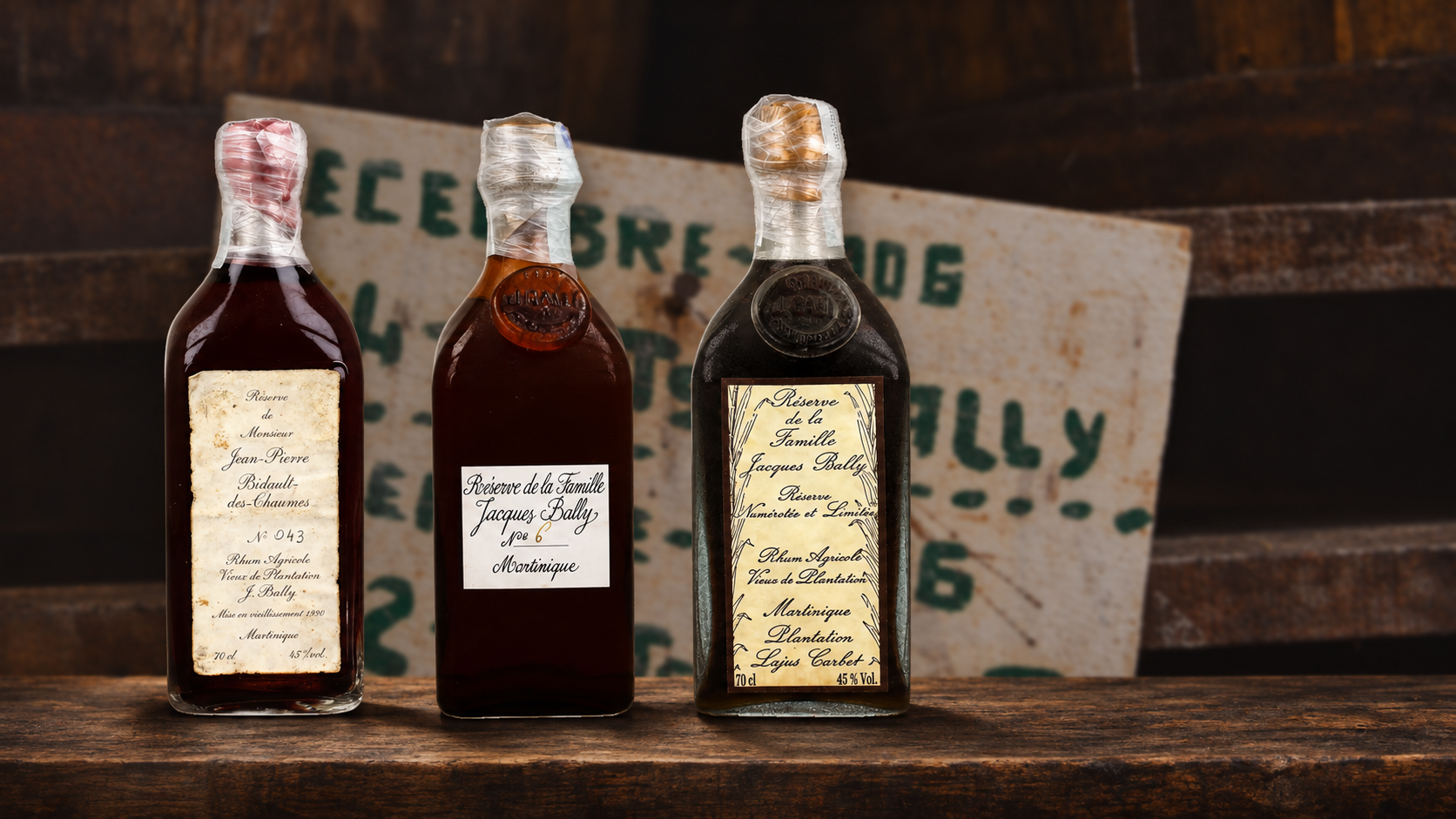
Several examples of special reserves from the J. Bally house, including the Réserve de Monsieur Jean-Pierre Bidault-des-Chaumes, bottle no. 043, laid down for ageing in 1990, and different presentations of the Réserve de la Famille Jacques Bally. ROW Spirits collection.
But our investigation had one final surprise in store. What happened to all these private barrels after Dominique de La Guigneraye left the company? Once again, we put the question to him. And his answer might well explain why some of these reserves now appear in such different presentations. According to his recollections, when Bally's stocks were consolidated at Habitation Saint-Étienne after his departure, those in charge at the time set about resolving the question of barrels belonging to private individuals. Dominique recalls that their owners were invited to collect what belonged to them: "Come and collect your barrels," they were reportedly told, since these reserves had already been paid for.
He also mentioned the emptying and bottling of stocks during this reorganisation. The exact sequence of events remains to be clarified, but one point is particularly interesting: not all the private barrels may have been bottled under the same conditions, or with the same presentations. Some owners may therefore have collected their rum before arranging for it to be bottled according to their own wishes. A possibility that could explain some of the unusual bottles we encounter today, although we cannot yet definitively link each example to this transitional period.
The exact launch date of the programme also remains to be established. Dominique told us that he hoped to find a surviving copy of the original parchment sent to prospective barrel owners, which included the date of the offer. A document that would be particularly valuable to our investigation. Although several reserves bear the inscription "Mise en vieillissement 1990", we still do not know exactly when potential buyers were approached, or how many barrels were ultimately sold or given away. Another mystery we very much hope to solve one day...
But our story does not end with Jean Bally's close acquaintances and the fortunate owners of these private reserves. Some admirers of his rum held rather more prestigious positions, reaching the very highest levels of government. And this brings us back to a fascinating interview that Luca Gargano conducted with Jean Bally in 1999, originally intended for television and eventually rediscovered on an old VHS tape. An exceptional testimony that we were able to publish on DuRhum in December 2015.
Asked about the political figures who appreciated his rums, Jean Bally mentioned Jacques Chirac. He recalled having given him several bottles to introduce him to the qualities of the family rum. And apparently, the gift had made quite an impression... According to Jean Bally, when Jacques Chirac was once offered another Martinican rum, he reportedly replied without hesitation: "For me, it's Bally!" An anecdote told with a smile and a few bursts of laughter, in Jean Bally's unmistakable style.
The story is not particularly surprising, either. In an article published by Le Monde on 2 April 1988, during a visit by Jacques Chirac to the French Caribbean, the journalist reported that Chirac was already claiming credit for introducing rum at receptions held by Paris City Hall. He therefore seems to have appreciated spirits from France's overseas territories long before his arrival at the Élysée Palace. Of course, this does not prove that Bally was served at all his receptions, but it certainly adds a little extra flavour to Jean Bally's recollections.
And since one president may hide another, Jean Bally also mentioned Georges Pompidou, who apparently appreciated his rum as well. However, he was careful to qualify this recollection himself, without offering any further details. We have found no personalised bottles associated with either of these two French presidents, and there is no evidence that special bottlings were produced specifically for them. But even their mention illustrates the reputation the Bally house had acquired far beyond Martinique!
Ultimately, from barrels purchased by private enthusiasts to reserves given to friends, from family blends to bottles presented to a President of the French Republic, the same idea keeps emerging: Bally rum was also a story of encounters, memories and shared heritage. Some bottles celebrated a particular personality, others bore the name of a specific owner, while a few bottles offered to friends helped spread the reputation of Jacques and Jean Bally's work. And behind all these names, famous or otherwise, another side of the house begins to emerge, sometimes far removed from its familiar pyramid-shaped bottles. A story that the labels only tell in part, and one that undoubtedly still holds a few secrets waiting to be uncovered... And we're working on it!